KR
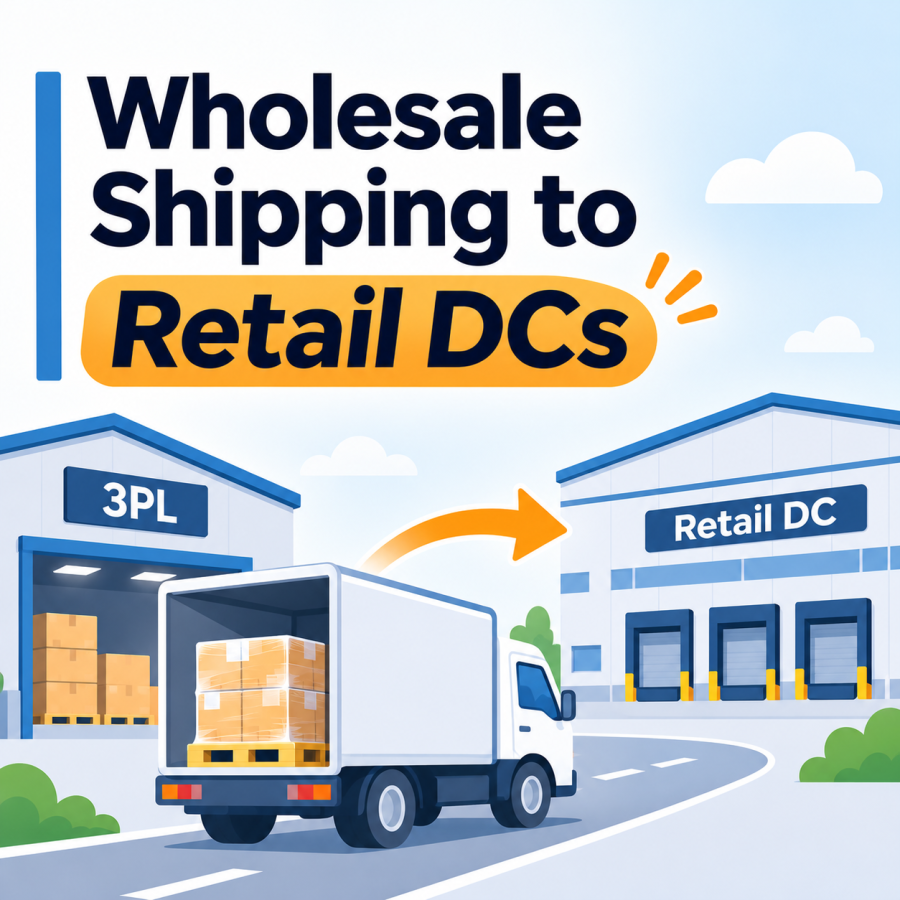
Shipping a wholesale order to a retailer is very different from fulfilling a direct-to-consumer (DTC) order. The goods may be the same, but the rules are not. Depending on the retailer’s vendor requirements, a distribution center (DC) may require specific shipping labels, an advance ship notice (ASN), a scheduled delivery appointment, and shipping documents that match the purchase order. A mistake in any of these can lead to a rejected delivery or a deduction from your invoice.
This guide explains how 3PL shipping to retail distribution centers works from purchase order to invoice, what documents and labels must line up, how LTL and FTL fit in, and where compliance chargebacks usually come from. It covers the whole process rather than one retailer’s label rules. For an example of retailer-specific labeling, see our separate guide to Walmart’s shipping label requirements for suppliers.
Why Retail DC Shipping Is Different
In DTC fulfillment, a package is picked, packed, and handed to a parcel carrier. In retail replenishment, the retailer sets the rules and measures you against them. Those rules are usually written in a routing guide or vendor compliance manual, and they cover things like:
- Label format and placement
- How cartons and pallets must be built
- Which EDI documents you must send, and when
- Whether you ship prepaid (you arrange freight) or collect (the retailer arranges freight)
- Delivery windows and appointment procedures
Because requirements differ between retailers and can change over time, a process that passes one retailer’s checks may fail another’s. Treat the current routing guide as the source of truth, not last year’s shipment.
Step 1: Start with the Routing Guide and the Purchase Order
Every retail shipment begins with a purchase order (PO). In EDI terms this is usually an 850, and it lists items, quantities, prices, the delivery location, and the requested delivery date.
Before anything is picked, confirm:
- The PO number, ship-to DC, and ship or delivery window
- Whether the order is prepaid or collect
- Any routing request or transportation step the retailer requires. Some retailers expect a routing confirmation within a set time after the PO, and the deadline is set by the retailer, so check yours.
- Pack requirements such as case pack, pallet configuration, and label type
Many suppliers also send a PO acknowledgment (EDI 855) to tell the retailer what can actually ship, including shortages or backorders, before the shipment is built.
Step 2: Pick, Pack, and Build Pallets to Spec
Retail pallets are judged at the DC dock, so build them to the routing guide before loading. Typical points to check are pallet type and grade, stacking pattern, maximum height and weight, wrapping, and whether mixed-SKU pallets are allowed. Pick against the PO line quantities, because a short or over-shipped line may be counted as an in-full failure.
Step 3: Label Cartons and Pallets
Retailers generally scan labels at receiving, so labels have to be readable and have to match the electronic data you send.
Depending on the retailer’s requirements, GS1-128 labels may be required at the carton level, pallet level, or both. These labels can encode an SSCC (Serial Shipping Container Code), an 18-digit identifier assigned to a specific logistics unit. The SSCC allows the retailer to match the physical carton or pallet with the corresponding shipment information in the ASN.
If a labeled logistics unit is broken down and rebuilt into a new unit, assign a new SSCC as required by GS1 standards and update the corresponding ASN data. Simply moving an intact, unchanged unit does not necessarily require a new SSCC.
In practice, that means:
- Do not print final labels until the shipment data is final.
- If a labeled pallet is rebuilt, do not reuse the old label. Assign a new SSCC and update the ASN.
- Check print quality and placement, and test labels before shipping where the retailer offers a way to do so.
Carton labels, item barcodes, and any retailer-specific marking are separate requirements, so follow the routing guide for each.
Step 4: Send the ASN on Time
The advance ship notice (ASN), usually EDI 856, communicates shipment details electronically to the retailer. Depending on the retailer’s requirements, it may need to be transmitted at shipment confirmation, within a specified period after departure, or before delivery. The ASN should reflect the actual shipped quantities and packaging hierarchy, including carton- or pallet-level SSCC information where required.
Industry sources describe ASN timing and accuracy as a common trouble spot, since a late, missing, or inaccurate ASN can cause a rejected delivery or a chargeback. Check the retailer’s exact deadline and data requirements before shipping.
The ASN should agree with everything else: the PO, the physical labels, the BOL, and the invoice. Common failure points include labels printed before shipment data was final, SSCCs reused too early, pallets rebuilt after labeling, and missing carton-level detail in the ASN.
Step 5: Choose LTL or FTL and Prepare the BOL
Retail DC freight usually moves as LTL (less-than-truckload) or FTL (full truckload).
- LTL is typically used when a PO or a group of POs fills only part of a trailer. The freight is consolidated with other shippers’ freight, so it often involves more handling and less control over timing.
- FTL is typically used for larger orders, where the pallet count justifies a dedicated trailer. It generally involves fewer touches and a more direct route.
The right choice depends on pallet count, weight, delivery windows, the retailer’s requirements, and cost. Ask for quotes on both when the order is near a break point, and confirm that the carrier can meet the retailer’s appointment and delivery-window rules.
The bill of lading (BOL) should match the PO and ASN: PO numbers, pallet or handling unit counts, weights, ship-to location, and any special handling or accessorial needs. Retailers and carriers may also require specific reference numbers on the BOL, so check the routing guide.
Step 6: Book the Delivery Appointment and Ship
Most retail DCs receive freight by appointment. In prepaid shipments, the supplier typically arranges transportation, while collect shipments generally follow the retailer’s routing instructions. The party responsible for booking delivery appointments may vary by retailer, carrier, and shipping program, so confirm the assigned responsibility before dispatch. Either way, missing a window can count against you.
Practical points:
- Confirm the delivery window for the PO, including whether early arrival is allowed
- Give the carrier the appointment details and the PO and BOL references
- Confirm the pickup time at the warehouse and the dock’s loading hours
- Keep proof of shipment and delivery, such as the signed BOL and any delivery receipt
If the carrier misses the pickup, contact its dispatch desk right away, get a new pickup time in writing, and find out whether the retailer appointment also needs to be moved.
Step 7: Invoice and Close the Loop
After shipment, the supplier typically sends an invoice (EDI 810). Retailers may reconcile the invoice against the purchase order and receiving records, while also checking shipment data against the ASN. Discrepancies in quantities, prices, or reference numbers can delay payment or result in deductions.
Where Compliance Chargebacks Come From
Retailer deductions and chargebacks generally come from a small number of root causes. One industry breakdown groups them into five categories:
- Operational errors, such as shortages, mispacks, and wrong unit counts
- Administrative errors, such as invoice and price mismatches
- ASN and EDI errors, such as late, missing, or inaccurate shipping notices
- Carrier and delivery failures, such as late deliveries and missed appointments
- Compliance gaps, such as labeling errors and pallet configuration violations
Penalty amounts, dispute windows, and rules vary by retailer and program, so read the compliance manual and check deductions against your shipment records when they appear. Keeping the PO, ASN, BOL, delivery proof, and photos together makes disputes much easier to answer.
Retail DC Shipping Checklist
- Current routing guide and PO terms reviewed, including prepaid or collect
- PO acknowledged, with shortages or backorders flagged early
- Pallets built to the routing guide (type, height, weight, wrap)
- Cartons and pallets labeled, with the SSCC and label data final and scannable
- ASN sent within the retailer’s required timing and matched to the labels and the BOL (where an ASN is required)
- LTL or FTL chosen based on pallet count, weight, windows, and cost
- BOL matches the PO, the ASN, and the handling unit count
- Delivery appointment booked or confirmed, and the carrier informed
- Proof of shipment and delivery saved
- Invoice matches the PO and the ASN
- Chargebacks reviewed against shipment records
What to Ask a 3PL Before You Hand Over Retail Orders
If you are choosing a 3PL for retail replenishment, ask:
- Which retailers and routing guides has the warehouse worked with?
- How does it handle EDI (850, 855, 856, 810), and does it use its own system or work through your EDI provider?
- Who prints the labels and checks placement and scan quality?
- Who books carriers and delivery appointments?
- How are shipment records kept, and who responds to chargebacks and scorecard disputes?
Key Takeaway
Shipping to a retail DC works when the PO, labels, ASN, BOL, appointment, and invoice all tell the same story. Most problems start when one of them does not. Build around the retailer’s current routing guide, finalize data before printing labels, and keep records of each step.
PNP LINE supports B2B and wholesale distribution with warehouse receiving, inventory management, pallet preparation, LTL and FTL shipping coordination, and delivery appointment assistance upon request. Retailer-specific labeling, EDI-related coordination, and other compliance requirements can be reviewed based on the customer’s needs and the warehouse’s available capabilities. Learn more about our 3PL services and drayage and trucking services.
📋 Request an Online Quote https://www.pnpline.com
Source References
- GS1 US, “An Introduction to the Serial Shipping Container Code (SSCC)” (Release 3.0, February 2019) — https://documents.gs1us.org/adobe/assets/deliver/urn:aaid:aem:494e625b-e1d8-4bbd-a1be-5918879cfc3d/An-Introduction-to-the-Serial-Shipping-Container-Code-SSCC.pdf
- SPS Commerce, “EDI for First-Time Suppliers: A Plain-English Guide to the Documents You’ll Send” (last updated May 20, 2026) — https://www.spscommerce.com/community/articles/edi-for-first-time-suppliers-a-plain-english-guide-to-the-documents-youll-send
- TrueCommerce, “SSCC Barcodes and GS1-128 Labels: What Suppliers Need to Know” (November 5, 2026) — https://www.truecommerce.com/en-gb/?p=56816
- SPS Commerce, “Deduction Management: The Five Root-Cause Categories Explained” (last updated September 29, 2026) — https://www.spscommerce.com/community/articles/deduction-management-the-five-root-cause-categories-explained
- SPS Commerce, “Label, Pack, Ship: A Guide to Walmart Supplier Requirements” (last updated August 14, 2025; prepaid and collect routing as an example) — https://www.spscommerce.com/community/articles/walmart-supplier-requirements
Disclaimer: Retailer routing guides, EDI requirements, label specifications, delivery windows, and chargeback rules differ by retailer, program, and product category, and they change over time. This article is provided for general informational purposes and does not constitute compliance or legal advice. Suppliers should confirm current requirements in each retailer’s official compliance documents or vendor portal before shipping.
#3PL shipping to retail distribution centers, #retail routing guide compliance, #EDI 856 advance ship notice, #GS1-128 pallet label, #SSCC pallet label, #retail DC delivery appointment, #retailer chargebacks, #wholesale order fulfillment, B2B 3PL