KR
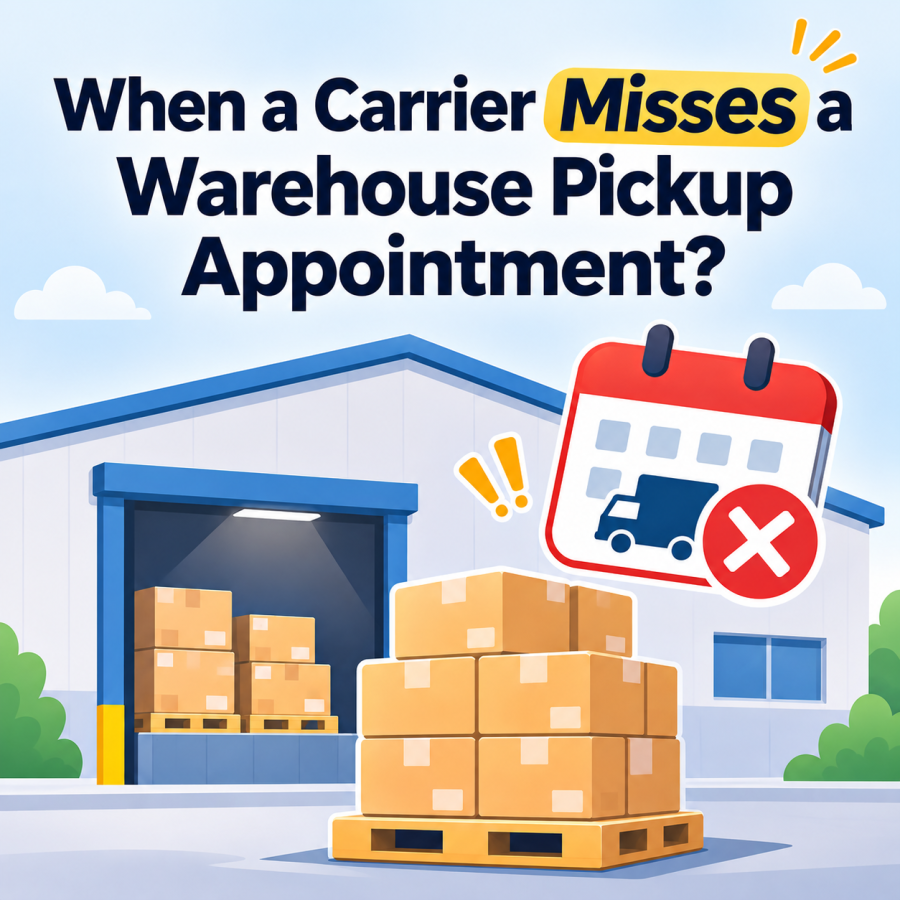
The freight is staged, the pallets are labeled, and the pickup window has closed, but the truck never came. A missed freight pickup at a warehouse is frustrating because the order is often tied to a delivery deadline, a retailer appointment, or an Amazon check-in date.
This guide walks through what to do in the first hours after a carrier misses a pickup: how to confirm what actually happened, which reference numbers to have ready, how to reschedule, how to protect the freight, and what records to keep. It is written for shippers, brands, and the warehouse teams that load their freight.
Why Carriers Miss Pickups
Not every missed pickup is the carrier’s fault, and it helps to know which kind you are dealing with before you call.
Common carrier-side causes include severe weather, traffic, truck breakdowns, a truck that is already full, a driver who runs out of hours, or delays at earlier stops. Many carriers also tend to run deliveries in the morning and pickups in the afternoon, so a late afternoon pickup window can be the first to slip.
Common shipper-side causes include incorrect or missing bill of lading (BOL) information, missing documents, packaging or labeling problems, a pickup location the truck cannot access, and accessorial services (such as a liftgate) that were not included in the booking.
A third category is a warehouse that closes before the carrier arrives. If your shipping dock closes at noon but the carrier plans afternoon pickups, the driver may arrive to a locked door. Confirm hours with the carrier at booking, not after the miss.
Step 1: Confirm the Pickup Was Actually Missed
Before escalating, rule out a simple mismatch.
- Check the dock log or security log for a driver check-in, even a brief one.
- Confirm the pickup window the carrier recorded, including the ready time and close time.
- Confirm the pickup was actually dispatched. Creating a BOL online does not always schedule the pickup by itself. Some carrier portals require a separate pickup request after the BOL is created.
- Check the carrier’s tracking page or notifications for a status such as driver assigned, en route, attempted, or rolled to the next day.
If the driver arrived and left, ask why. A “freight not ready,” “no access,” or “documents incomplete” note changes who is responsible for the next step.
Step 2: Gather Your Reference Numbers
Dispatch and terminal staff will ask for identifying numbers before they can look up the shipment. Have these ready:
- Pickup reference (confirmation) number. Many carriers generate this when the pickup request is submitted. Some carriers confirm online without a separate number, so ask what the carrier uses.
- PRO number. The carrier’s shipment tracking number. Depending on the carrier and its system, a PRO number may be assigned before pickup, at pickup, or after the shipment enters the carrier’s network. If no PRO number is available yet, use the pickup confirmation or BOL number when contacting the carrier.
- BOL number and shipper, consignee, and origin details.
- Pickup window and dock hours as submitted.
- Pallet or piece count, total weight, and dimensions as booked.
- Any appointment or purchase order reference tied to the delivery, if the freight is going to a retailer or an Amazon facility.
Practices vary by carrier, so treat this list as a starting point rather than a universal rule.
Step 3: Contact Dispatch or the Local Terminal
Call the carrier’s dispatch desk or the local terminal that serves your warehouse, and follow up in writing by email or through the carrier portal so there is a time-stamped record. A short list of questions keeps the call productive:
- Was the pickup assigned to a driver, and what is the current status?
- Why was it missed, and is it noted as a carrier issue or a shipper issue?
- When is the earliest new pickup, and will it roll over automatically or must we rebook?
- Is there a same-day option if we call before a cutoff?
- Will any fees apply to the rebooked pickup?
- Who is the contact if the pickup is missed again?
Carrier policies differ on what happens next. Some carriers will confirm a new date, often the next business day, while others expect the shipper to submit a new request. When scheduling a pickup, ask whether missed pickups are automatically rolled over to the next business day or require a new booking. If the pickup has already been missed, confirm the next available pickup date directly with the carrier.
Step 4: Reschedule, Escalate, or Rebook
You generally have three options.
- Keep the carrier and reschedule. This is often the simplest fix for a one-time miss caused by weather or a full truck. Ask for the new window in writing and make sure the old request is closed so you do not end up with two pickups.
- Escalate within the carrier. If the pickup is time-critical, ask for a supervisor or terminal manager, and share the delivery deadline.
- Rebook with another carrier. If the same carrier has missed several pickups, or the freight must move today, a different carrier may be the better option. Cancel the original request first so the freight is not double-booked, and check whether the new carrier needs a fresh BOL. Obtain confirmation that the original pickup request has been canceled before releasing the freight to another carrier, since a driver may already have been dispatched.
Keep in mind that LTL carriers generally do not guarantee pickup times. For example, the rules tariff published by TForce Freight states that the carrier agrees to move freight with reasonable dispatch and is not bound to a particular schedule unless agreed in writing in advance. Other carriers have their own tariffs and optional guaranteed services, so review the terms that apply to your shipment instead of assuming a missed pickup entitles you to compensation.
Step 5: Protect the Freight at the Warehouse
A missed pickup leaves finished pallets taking up dock space and floor positions.
- Keep the freight staged and intact. Leave the stretch wrap and labels as they are, and keep the pallets away from the active dock so they are not moved or mixed with other orders.
- Bring outdoor freight inside. If freight is waiting at a curb or yard, move it indoors overnight and protect it from weather and theft.
- Check dock hours. Tell the carrier the latest time the warehouse can load, since early closing is a common reason for repeat misses.
- Ask about additional storage or handling. Additional storage, re-staging, or handling charges may apply depending on the warehouse’s service agreement, the duration of the delay, and whether additional labor or equipment is required. Confirm any potential charges with your 3PL before rescheduling.
If the freight is bound for a retailer or Amazon, also ask the carrier or warehouse whether the delivery appointment needs to be moved, since the appointment may be separate from the pickup.
Step 6: Document the Handoff When the Carrier Does Arrive
Good records protect you if there is a later dispute over timing, missing freight, or charges. At pickup, make sure the following are recorded:
- Driver check-in: arrival time, driver name, and carrier or truck identification.
- Proof of pickup: Obtain a signed BOL, electronic pickup receipt, or other carrier-acknowledged proof of freight acceptance, as applicable. Verify the pickup date, handling unit count, and any exceptions. Under 49 CFR § 373.101, applicable carriers have bill of lading or receipt requirements for property accepted for transportation, but the documentation process may vary by carrier and shipment.
- Piece or pallet count: compare the count on the BOL against what actually loaded, and note any exceptions before the driver leaves.
- PRO number: Record the PRO number provided by the carrier, if available, and verify that it matches the shipment paperwork or tracking record. Some carriers assign or update the PRO number after pickup, so confirm the tracking reference once the shipment enters the carrier’s network.
- Time stamps and photos of the loaded freight, if your warehouse takes them as part of its process.
Keep copies of the pickup request, emails with dispatch, and the proof of pickup together in one shipment record.
What About Costs?
A missed pickup does not automatically mean anyone owes anyone money. A few points are worth knowing:
- Carriers’ rules tariffs usually limit liability for delay, and many exclude consequential damages. Confirm the language in your carrier’s tariff or contract.
- If freight is not ready or the pickup cannot be completed due to shipper-side issues, attempted-pickup or other accessorial charges may apply. Freight reclassification or reweigh charges may also arise when the declared freight class, weight, or dimensions differ from the carrier’s findings.
- Rebooking with a different carrier may change the rate.
- Warehouse storage or handling fees are governed by your service agreement.
Costs, deadlines, and liability vary by carrier, contract, and shipment, so verify them for your specific shipment.
Missed Pickup Checklist
- Pickup request, BOL, and carrier confirmation were all completed
- Pickup window and warehouse dock hours match what the carrier recorded
- Pickup reference number, BOL number, and PRO number (if assigned) recorded
- Carrier dispatch or terminal contacted, with the call followed up in writing
- Reason for the miss and the new pickup window confirmed
- Original pickup request canceled if the freight was rebooked elsewhere
- Freight kept staged, labeled, and protected
- Downstream delivery appointment checked and moved if needed
- Driver check-in, proof of pickup (signed BOL or electronic receipt), and handling unit count recorded at the actual pickup
- Charges reviewed against the carrier tariff and your warehouse agreement
Key Takeaway
A missed freight pickup at a warehouse is easier to resolve when the facts are in one place: reference numbers, pickup window, dock hours, and proof of pickup. Confirm what happened first, reschedule in writing, protect the freight, and keep records of the handoff.
PNP LINE supports U.S. shippers with warehouse receiving, pallet dispatch by LTL or FTL, and domestic trucking coordination upon request. The scope of pickup and carrier coordination can be arranged according to your requirements and the warehouse’s capabilities. Learn more about our 3PL services and drayage and trucking options.
📋 Request an Online Quote https://www.pnpline.com
Source References
- U.S. Code of Federal Regulations (via Cornell Law School Legal Information Institute), 49 CFR § 373.101, “Bills of lading” — https://www.law.cornell.edu/cfr/text/49/373.101
- FedEx Freight, “Schedule a FedEx Freight pickup” (ready time, close time, and pickup request guidance) — https://www.fedexfreight.com/en-us/rate-ship/shipping/schedule-pickup
- TForce Freight, Rules Tariff UPGF 102 (version T; file dated August 3, 2026 in URL) — https://www.tforcefreight.com/downloads/UPGF-102-T-20260803.pdf
- Freight Center, “What You Can Do to Avoid Missed Pickups” — https://www.freightcenter.com/what-you-can-do-to-avoid-missed-pickups/
- Shipwell Help Center, “LTL Pickup and PRO Numbers” — https://intercom.help/shipwell/en/articles/9268914-ltl-pickup-pro-numbers
- Quote Factory Support, “What if my carrier doesn’t show up?” — https://support.quotefactory.com/article/18-what-if-my-carrier-doesnt-show-up
Disclaimer: Pickup procedures, reference numbers, fees, liability terms, and rescheduling policies vary by carrier, contract, shipment type, and location. This article is provided for general informational purposes and does not constitute legal or transportation advice. Shippers should confirm the terms that apply to their shipment with their carrier and warehouse.
#missed freight pickup at warehouse, #carrier missed pickup LTL, #carrier no-show warehouse pickup, #how to reschedule a freight pickup, #freight pickup reference number, #PRO number vs pickup number, #bill of lading proof of pickup