KR

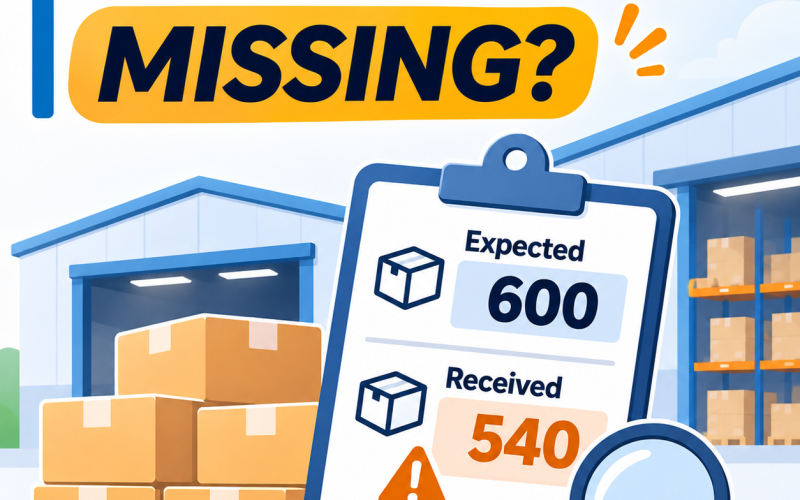
The packing list says 1,200 units. The warehouse counts 1,176. Or the count is right, but it is spread across SKUs that do not match your system. Receiving discrepancies on imported goods are common, and the longer they go unnoticed, the harder they are to trace.
This guide explains the main causes of 3PL receiving inventory discrepancies, what to set up before a shipment arrives, how to count and inspect at the dock, how to document and resolve problems, and when a claim may be possible. It is written for importers and brands that send containers or pallets to a U.S. 3PL. For the wider process after a container arrives, see our guide to what happens after your container arrives in Houston. This article goes deeper on counting, mismatches, and evidence.
What Is a Receiving Discrepancy?
A receiving discrepancy is a mismatch between what the warehouse physically receives and what the inbound documents say. It usually falls into one of these types:
- Shortage: fewer units, cartons, or pallets than documented
- Overage: more than documented
- Wrong SKU: items that do not match the PO or packing list
- Damage: visible damage to cartons, pallets, or product
- Documentation mismatch: inconsistent carton counts, weights, or missing paperwork
Why Counts Do Not Match
Many discrepancies start before the cargo leaves the origin factory or consolidator.
- Packing list errors. The list may be built from the planned order, not from what was actually loaded.
- Different units of measure. One side counts cartons, the other counts pieces, inner packs, or sets.
- SKU naming and mapping. The factory uses its own item codes, and your system uses another. Without a mapping table, receivers may book units against the wrong SKU.
- Mixed or unlabeled cartons. Several SKUs in one carton, or cartons without clear marks, make counting slow and error-prone.
- Shipper’s load and count. For a sealed ocean container, the bill of lading generally describes the contents as loaded and counted by the shipper. A carrier is not normally verifying what is inside.
- Transit damage or loss. Crushed cartons, water damage, or missing cartons can appear after a long journey.
- Receiving errors. Miscounts, wrong scans, or a pallet received against the wrong receipt.
An intact container seal does not guarantee that the quantity loaded at origin matches the packing list. When a shortage is discovered during devanning, compare the origin loading records, container seal information, unloading photos, and warehouse receiving report before determining where the discrepancy may have occurred. An intact seal does not by itself show that the carrier or warehouse is free of responsibility, and a shortage alone does not show that the carrier is responsible.
Before the Shipment Arrives: Set Up the Count to Succeed
Prevention is cheaper than investigation. Before cargo ships, aim to give the warehouse:
- A clean packing list by carton, pallet, and SKU, with quantities per carton and the unit of measure stated
- A SKU mapping table that links factory codes to your SKUs
- Carton marks and pallet labels that match the list
- Expected pallet and carton counts, and container and seal numbers for container shipments
- An advance notice or receipt in the warehouse’s system, if the 3PL receives against an expected receipt
- Loading photos from origin, if your supplier or forwarder can provide them
Ask the warehouse how it prefers documents to be sent, and agree on a standard format with your supplier early.
At the Dock: Count and Inspect
A consistent receiving routine makes counts defensible.
- Check the container and seal. Record the container number and seal number, and note whether the seal is intact before opening.
- Photograph before unloading. Take photos of the container door, the load as it appears, and any visible damage.
- Count pallets and cartons. Compare the physical handling unit count against the packing list and carrier paperwork.
- Inspect for visible damage. Look at cartons, pallets, wrap, and labels, and record the condition.
- Verify SKU quantities according to the agreed receiving scope. If the warehouse performs carton-level receiving only, SKU unit quantities may be recorded based on supplier-provided packing information rather than independently verified through an open-carton count. Arrange piece-level verification separately when required, and use your SKU mapping table either way.
- Note exceptions on the delivery receipt when freight arrives by truck. Write what is wrong, where, and how many pieces, instead of a vague note such as “damaged.”
Cargo that has a visible problem should be set apart from normal inventory until it is reviewed.
Standard receiving versus blind receiving
In standard receiving, the receiver sees the expected quantities from the PO or ASN and checks against them. It is faster, and works well when suppliers have a reliable accuracy record.
In blind receiving, the receiver does not see the expected quantities and counts what physically arrived. It can reduce confirmation bias, because receivers count the physical goods without seeing the expected quantities. However, accuracy depends on the warehouse’s counting procedures, SKU identification, staff training, and the level of inspection performed. It may also require additional labor compared with standard receiving. Many operations use a hybrid, for example blind counts for new suppliers, high-value items, or when variances are large. Ask the 3PL which methods it can support, and whether they are available for your shipments.
After the Count: Log, Quarantine, and Resolve
When the count does not match, the first hours matter most.
- Log the discrepancy immediately, with the type, SKU, quantity, and time.
- Recount the affected cartons or pallets before escalating.
- Quarantine disputed or damaged goods so they are not put away or shipped.
- Attach references: packing list, container or carrier paperwork, ASN or PO, and photos.
- Update available inventory so orders are not promised against units that may not exist.
- Notify the right party: the supplier for shortages and wrong items, the carrier for transit damage, and your own team for any PO or invoice impact.
A written receiving report that records expected and received quantities, SKU, condition, exceptions, and reference numbers becomes the basis for every follow-up conversation.
Photo Evidence and Claims
Photos with a visible date and time, taken before opening, during unloading, and of each damaged unit, are among the most useful records you can create. Keep damaged packaging and goods until the carrier has had a chance to inspect them, unless the carrier releases them in writing.
If transit damage or loss is involved:
- Check the applicable deadlines immediately. Requirements vary by transportation mode, governing law, bill of lading, and carrier contract. Domestic U.S. motor-carrier claims and international ocean-cargo claims may follow different rules, and deadlines for notifying a carrier, filing a written claim, and bringing a lawsuit are not necessarily the same.
- A delivery receipt notation is not the same as a formal cargo claim. For claims subject to 49 CFR Part 370, a written claim generally must identify the shipment, assert carrier liability, and request a specified or determinable amount. International ocean shipments and other transportation arrangements may be subject to different claims procedures and legal requirements.
- Sealed containers are harder. Because ocean bills of lading usually describe contents as shipper’s load and count, importers typically need other evidence of what was loaded and in what condition. Photos from origin and a clean packing list help.
Claim rules vary by carrier, mode, and contract, so confirm the process that applies to your shipment.
Cycle Counts: Catching What Receiving Missed
Even careful receiving can miss a few errors. A cycle count, which is a rolling count of selected SKUs or locations instead of one annual shutdown, helps find errors before they become stock-outs. Many operations count high-value, fast-moving, or recently received SKUs more often. Counting soon after putaway can also reveal a location or SKU mapping mistake while the paperwork is still fresh.
Receiving Discrepancy Checklist
- Packing list is by carton, pallet, and SKU, with quantities and unit of measure
- SKU mapping table shared with the warehouse
- Carton marks and pallet labels match the documents
- Container number, seal number, and seal condition recorded
- Photos taken before and during unloading
- Pallets and cartons counted, and SKU quantities verified according to the agreed receiving scope (carton-level or piece-level)
- Visible damage noted, and delivery receipt exceptions written clearly
- Discrepancies logged, recounted, and quarantined
- Receiving report completed with references and photos
- Claim deadline checked in the bill of lading or carrier contract
- Cycle counts scheduled for recently received SKUs
What to Agree on with Your 3PL
Before your first import shipment, confirm with the warehouse:
- How shipments are received, whether receiving is carton-level only or includes open-carton piece-level counts, and whether blind or sampled counts are available
- How discrepancies are reported, and how quickly
- Whether photos of damage and containers are taken, and who stores them
- What a receiving report includes
- How cycle counts are handled
- Who communicates with the supplier, forwarder, or carrier when something is wrong
Key Takeaway
Receiving discrepancies can originate at multiple points, from supplier packing and documentation to transportation, unloading, counting, and warehouse system entry. Accurate shipment data, consistent receiving procedures, and detailed receiving reports help identify discrepancies and resolve them more efficiently.
PNP LINE provides U.S. warehousing and 3PL receiving services for container, LTL, and parcel shipments, including inbound inventory recording and warehouse management support. Receiving procedures, carton or unit-level count verification, visible damage documentation, and discrepancy reporting can be arranged based on the customer’s requirements and the warehouse’s available capabilities. Learn more about our 3PL services.
📋 Request an Online Quote https://www.pnpline.com
Source References
- U.S. Code of Federal Regulations, 49 CFR Part 370, “Principles and Practices for the Investigation and Voluntary Disposition of Loss and Damage Claims and Processing Salvage” (including § 370.3, filing of claims; GovInfo, 2022 edition) — https://www.govinfo.gov/content/pkg/CFR-2022-title49-vol5/pdf/CFR-2022-title49-vol5-part370.pdf
- Racklify Encyclopedia, “What Is a Receiving Discrepancy in Warehouse Operations?” (published October 13, 2026; updated October 22, 2026) — https://racklify.com/encyclopedia/what-is-a-receiving-discrepancy-in-warehouse-operations/
- Racklify Encyclopedia, “Blind Receiving Versus Standard Receiving: Pros, Cons, and When to Use Each” (published August 3, 2026; updated September 10, 2026) — https://racklify.com/encyclopedia/blind-receiving-versus-standard-receiving-pros-cons-and-when-to-use-each/
- Montgomery McCracken Walker & Rhoads LLP, “Goods Shipped in Sealed Sea Containers Require Actual Proof of Good Order of the Contents” (April 23, 2014) — https://www.mmwr.com/goods-shipped-in-sealed-sea-containers-require-actual-proof-of-good-order-of-the-contents
- Freight Sidekick, “Freight Delivery Receipt” (noting exceptions at delivery) — https://freightsidekick.com/resources/freight-delivery-receipt
- Extensiv, “Receiving Against an ASN” (example of variance reporting in a WMS) — https://help.extensiv.com/receiving-against-an-asn
Disclaimer: Receiving procedures, carrier liability, claim deadlines, and documentation requirements vary by carrier, transport mode, contract, and shipment. This article is provided for general informational purposes and does not constitute legal or claims advice. Importers should confirm the terms that apply to their shipment with their carrier, forwarder, and warehouse.
#3PL receiving inventory discrepancies, #warehouse receiving discrepancies, #packing list vs actual count, #shortage and overage at receiving, #blind receiving, #SKU mapping errors, #container devanning count, #receiving report