KR
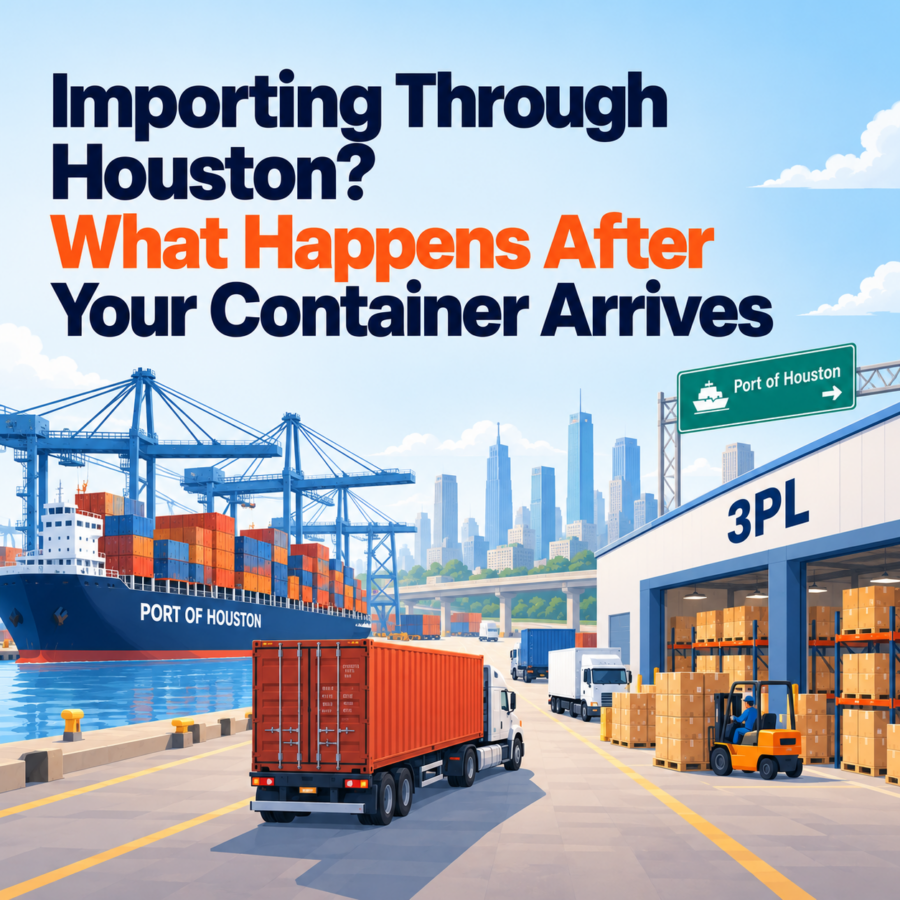
Watching a container’s status change from “on vessel” to “delivered” can feel like a black box, especially for importers who haven’t moved freight through Houston before. In practice, it’s a sequence of fairly well-defined steps — some handled by the carrier and terminal, some by your customs broker, and some by your warehouse or 3PL. Knowing what happens at each stage makes it easier to spot delays early and to understand which charges are normal and which ones are worth questioning.
This walks through what actually happens between a vessel’s arrival at the Port of Houston and a finished order reaching a retailer, distributor, or end customer.
Step 1: Vessel Arrival
Before a vessel reaches Houston, key advance cargo information must already be submitted to CBP. For most U.S.-bound ocean imports, the importer is responsible for ensuring that the Importer Security Filing (ISF, commonly called “10+2”) is submitted no later than 24 hours before the cargo is loaded onto the vessel at the foreign port — not 24 hours before U.S. arrival. Separately, the ocean carrier is responsible for submitting the required cargo manifest information to CBP under applicable regulations. Late, missing, or inaccurate ISF filings can trigger liquidated damages of up to $5,000 per violation, and CBP can issue a “do-not-load” order in more serious cases, which blocks the cargo from being loaded in the first place.
Once the vessel is underway, CBP and other agencies begin assessing risk using the ISF and manifest data, which is part of why accurate, on-time filing matters well before the ship reaches the Houston Ship Channel. When the vessel actually arrives and berths — at Barbours Cut, Bayport, or one of Port Houston’s other terminals — the container is discharged from the vessel onto the terminal, where it sits until it clears the next stage.
Step 2: Customs Clearance
Arrival at the terminal doesn’t mean the container is available for pickup. It first needs to clear customs, which generally follows this pattern:
- Entry filing. For many commercial shipments valued at $2,500 or more, a formal customs entry is generally required, although exceptions and additional requirements may apply depending on the merchandise. The importer or its authorized licensed customs broker submits the required entry information using documents such as the commercial invoice, packing list, bill of lading, and applicable regulatory documentation. The ISF is a separate advance security filing and does not replace the customs entry.
- Risk-based targeting. CBP evaluates the shipment against its targeting rules. Most shipments clear without further action. Others are flagged with a hold — common types include a Participating Government Agency (PGA) hold, placed when FDA, USDA, CPSC, or another agency needs to confirm regulatory compliance, or a broader commercial enforcement hold tied to the product or shipper.
- Exam, if triggered. If CBP selects a shipment for examination, it may undergo a documentation review, a non-intrusive inspection (NII, sometimes referred to by the X-ray technology used), or an intensive physical examination, depending on the risk assessment — these aren’t necessarily sequential, and which one applies depends on the specific concern CBP is checking. An intensive examination may require the container to be transferred to a designated examination facility for unloading and inspection. Exam-related charges and delays vary significantly by examination type, facility, container size, and handling requirements, and the importer is generally responsible for applicable costs.
- Release. Once CBP is satisfied — whether immediately or after a hold or exam is resolved — the shipment receives customs release.
Customs release is necessary but not sufficient on its own; see Step 3 for what else has to happen before the container can actually move.
Step 3: Container Availability
A container isn’t available for pickup the moment customs clears it. Three key conditions generally need to be satisfied before pickup: CBP customs release, carrier release (which can involve bill of lading surrender or telex release requirements in addition to confirming freight charges are paid, depending on the shipment), and terminal availability, with no outstanding holds or charges preventing delivery. Clearing one doesn’t automatically clear the others, and a delay in any one of them can hold up pickup even after the others are in place.
Each carrier’s tariff sets a “free time” window — commonly a handful of days from discharge or vessel arrival — after which demurrage (storage charges for a container still sitting at the terminal) and detention (charges for an empty container not returned on time after leaving the terminal) can begin accruing. These windows aren’t fixed nationally or even port-wide: Port Houston shortened its free time specifically for loaded refrigerated import containers at Barbours Cut and Bayport effective May 1, 2026, part of a broader effort by the port to encourage faster cargo pickup. That kind of change can happen on relatively short notice and doesn’t necessarily apply the same way to standard dry containers, which is exactly why it’s worth confirming current free time and the “last free day” for your specific container and carrier — through your broker or forwarder — rather than assuming a fixed number of days.
Step 4: Drayage to the Warehouse
Once a container is fully released, a drayage carrier — a short-haul trucking provider specializing in moving containers between the terminal and a nearby warehouse or rail yard — picks it up. This leg is short in distance but operationally important: chassis availability, drayage driver capacity, and terminal congestion all affect how quickly a released container actually leaves the port.
Houston’s highway network gives drayage providers reasonably direct routes to warehouses across the metro area, with Interstate 10 running east-west, Interstate 45 connecting north toward Dallas-Fort Worth, and Interstate 69 running toward the Midwest. For cargo moving further inland rather than to a local warehouse, Barbours Cut Container Terminal’s on-dock intermodal rail service, connected to both Union Pacific and BNSF, offers a rail option that skips a separate drayage move to an off-site rail yard.
Step 5: Devanning and Receiving
At the warehouse, devanning — unloading the container — is its own process rather than a quick afterthought. It typically includes:
- Pre-arrival prep, confirming the bill of lading and packing list are on hand and that the right equipment (forklifts, pallet jacks, or conveyors, depending on the cargo) and labor are scheduled for when the container is expected.
- Safe, methodical unloading, with handling adjusted for container type — a standard dry container, a refrigerated unit, and an oversized load each call for different equipment and sequencing.
- Receiving and WMS entry, which typically includes checking shipment quantities and visible condition against the provided documents, recording any discrepancies, and updating the warehouse management system (WMS) accordingly. Additional labeling, detailed quality inspections, or other value-added services may be performed depending on the agreed scope of work with your 3PL.
- Routing, either into storage or, for time-sensitive freight, cross-docked directly onto an outbound truck without being shelved at all.
A shorter, more predictable port-to-warehouse distance — the advantage of a Houston-area facility for Gulf Coast and Texas-bound freight — generally makes it easier to schedule labor around when a container is actually expected, rather than building in a wide buffer for transit uncertainty on a longer haul.
Step 6: Storage and Inventory
Once received, inventory typically sits in general dry storage, climate-controlled space, or, for specific product and business profiles, a Foreign Trade Zone. Houston’s Foreign Trade Zone 84 can be relevant for importers who want to defer, reduce, or in some cases eliminate duty on goods that are re-exported rather than sold domestically — but that benefit applies only to inventory actually stored within an FTZ-designated facility or approved operating area, not to goods held in a general Houston warehouse. Eligibility depends on the product, the intended use, and the specific facility, and is worth confirming with a licensed customs broker rather than assuming it applies.
From here, inventory accuracy depends on the WMS tracking what’s on hand, where it’s located within the facility, and how it’s allocated across outbound orders — the foundation for the next step, regardless of whether those orders are a handful of pallets to a distributor or a continuous stream of individual parcels.
Step 7: B2B or DTC Fulfillment
The final step looks different depending on who the customer is.
For B2B distribution — full truckload or LTL shipments to retailers, distributors, or wholesale accounts — Houston’s highway and rail access shortens transit time to a meaningful share of customers across Texas and the broader Gulf region, which is the main practical advantage of staging B2B inventory there rather than on a coast further from that demand.
For direct-to-consumer (DTC) or e-commerce fulfillment, orders are picked, packed, and handed to a parcel carrier individually. A Houston warehouse can provide relatively short parcel transit times to many Texas destinations and nearby South-Central markets, though actual delivery speed depends on the carrier, service level, and destination ZIP code — it won’t outperform a more centrally located warehouse for nationwide delivery speed, and the advantage is strongest when a meaningful share of your customer base is already in or near that region.
What Importers Should Prepare For
A few practical things are worth having in place before your container reaches Houston, regardless of which step it’s currently in:
- ISF filed accurately and on time, well before the vessel loads, not before it arrives.
- A customs broker relationship established in advance, so entry filing and any hold response can happen without delay.
- Clarity on your container’s specific free time and last free day, confirmed with your carrier or forwarder rather than assumed from a general rule of thumb.
- A drayage and warehouse plan that accounts for chassis and labor availability, particularly during periods of higher port volume.
- A WMS and receiving process at your warehouse that can accurately capture inventory as it’s devanned, so B2B and DTC fulfillment can draw on accurate stock data from day one.
Key Takeaway
Getting a container from “arrived at Port Houston” to “delivered to the customer” involves several distinct handoffs — CBP and the ISF filing, the carrier and terminal’s release process, a drayage move, devanning and receiving at the warehouse, and finally outbound fulfillment — each with its own timing, documentation, and potential points of delay. Understanding where your shipment is in that sequence, and which party is responsible for each step, makes it much easier to catch a delay early and to know which charges are routine versus worth questioning.
PNP LINE manages this process for importers end to end — international freight forwarding to get cargo to Houston, customs clearance coordination through licensed customs broker partners, drayage, and warehousing and fulfillment once the container is on the ground. Learn more about our Texas warehouse, international freight forwarding, and U.S. customs clearance services.
📋 Request an Online Quote
https://www.pnpline.com
Source References
- U.S. Customs and Border Protection, “Importer Security Filing (ISF) ‘Ten Plus Two’ Program” — https://www.cbp.gov/trade/trade-community/programs-outreach/importer-security-filing-ten-plus-two
- U.S. Customs and Border Protection, “Importing into the United States: A Guide for Commercial Importers” — https://www.cbp.gov/sites/default/files/documents/Importing%20into%20the%20U.S.pdf
- Port Houston, “Port Statistics” — https://porthouston.com/about/our-port/statistics/
- Port Houston, “Rail Connectivity Enhances Efficiencies at Port Houston” — https://porthouston.com/rail-connectivity-enhances-efficiencies-at-port-houston/
- FreightWaves, “Port Houston tonnage rises 4% as officials cut reefer free time,” March 2026 — https://www.freightwaves.com/news/port-houston-tonnage-rises-4-as-officials-cut-reefer-free-time
- U.S. Department of Commerce, International Trade Administration, Foreign-Trade Zone 84 (Houston) zone details — https://ofis.trade.gov/Zones/Details/255
Disclaimer: Customs holds, exam fees, carrier free time, demurrage and detention rules, and terminal procedures can vary by carrier, container type, and shipment, and are subject to change with little notice. This article is provided for general informational purposes and does not constitute legal, customs, or compliance advice. Importers should confirm current requirements, fees, and timelines with their licensed customs broker, carrier, or freight forwarder for their specific shipment.
#Houston 3PL for importers, #Houston warehouse for imported goods, #Houston container receiving, #Houston import logistics, #Houston 3PL warehouse, #Port of Houston fulfillment