KR
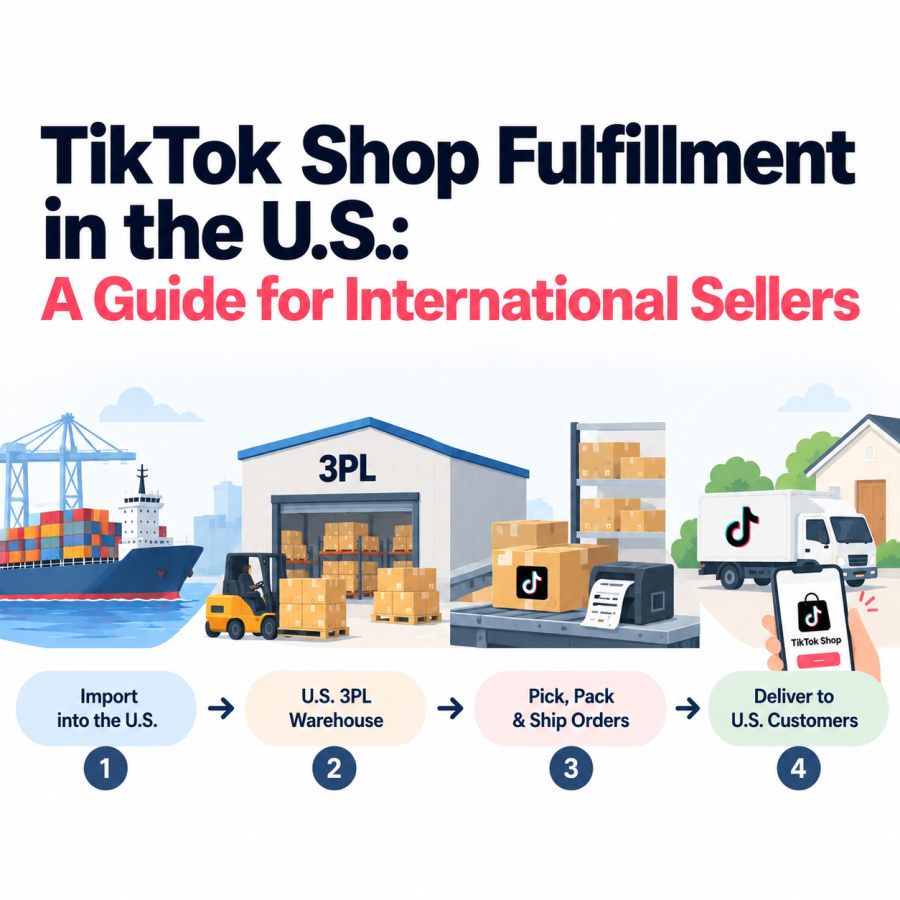
For an international brand, TikTok Shop can move product quickly, but fast sales create fast operational problems. Orders come in bursts after a video takes off, buyers expect U.S.-based delivery speeds, and the platform measures how quickly you ship and how reliably packages arrive.
A TikTok Shop 3PL for international sellers solves much of that by putting your inventory in a U.S. warehouse, where it can be picked, packed, and shipped domestically. This guide explains how that works, what to prepare, and what to check with TikTok Shop before you commit to a setup.
A note before you start: TikTok Shop’s fulfillment programs, shipping rules, fees, and seller requirements are updated regularly, and some options are available only to certain sellers. Treat this article as a framework, and confirm current details in your Seller Center and TikTok Shop Academy before making decisions.
Why U.S. Fulfillment Matters for TikTok Shop Sellers
TikTok Shop sets shipping expectations for U.S. orders. According to TikTok Shop’s Fulfillment Policy, regular orders generally must be marked In Transit within 2 business days and Delivered within 6 business days of reaching Awaiting Shipment status. Orders that are not updated to Awaiting Collection within 5 business days may be automatically canceled. Specific requirements and exceptions vary by order type and fulfillment option, so sellers should confirm the current policy in Seller Center. TikTok also tracks seller performance metrics, such as late dispatch, on-time delivery, and seller-fault cancellations, and poor results can lead to enforcement such as reduced visibility or account penalties. Exact thresholds and exemptions depend on the fulfillment option you use, so check the current policy in Seller Center.
For a seller shipping each order individually from overseas, meeting a delivery window like that can be difficult. There is also a customs consideration. The U.S. has suspended the $800 de minimis exemption for most low-value imports. CBP’s interim final rule effective June 24, 2026 requires qualifying shipments arriving through non-postal channels to use applicable formal or informal entry procedures, while international postal shipments are addressed under separate rules. Importers should confirm the current requirements for their shipping method, product, and country of origin with a licensed customs broker.
There is also a program-level reason. TikTok Shipping, the platform’s labeled-shipping option, is described by TikTok as a U.S. domestic service and does not support cross-border warehouses. Holding inventory in the United States is the foundation for using it, and for most other U.S. fulfillment setups.
TikTok Shop currently describes three broad fulfillment paths, depending on seller eligibility:
- Fulfilled by TikTok (FBT): you send inventory to TikTok’s U.S. fulfillment network, and TikTok handles storage, picking, packing, shipping, and returns for enrolled products.
- TikTok Shipping: you ship from your own or a third-party warehouse, such as a 3PL, using labels TikTok provides.
- Seller Shipping: you ship from your own or a third-party warehouse using carriers you choose. TikTok notes that this option may be available only to select sellers, so confirm eligibility in your Seller Center.
A U.S. 3PL most directly supports the second and third options, and many brands also use a 3PL alongside FBT, keeping some SKUs in TikTok’s network and the rest at their own warehouse.
Sending Inventory to a U.S. 3PL
Before inventory can sit in a U.S. warehouse, it has to be imported. For ocean freight, that generally means:
- Importer of Record (IOR) setup. The IOR is legally responsible for the import. Foreign IOR rules are being tightened under Executive Order 14411, so confirm your structure with a licensed customs broker before your next shipment.
- An Importer Security Filing (ISF). For most ocean imports, the ISF must be submitted to U.S. Customs and Border Protection no later than 24 hours before cargo is loaded at the foreign port. CBP explains the program on its ISF page.
- A customs entry and bond. For many commercial shipments valued at $2,500 or more, a formal entry is generally required, although exceptions may apply. The ISF is a separate filing and does not replace the entry.
- Correct classification and duty treatment. Final duties depend on HTS classification, country of origin, and any additional duties, not on the HTS code alone.
Once cargo clears and reaches the 3PL, receiving typically includes checking quantities and visible condition against your documents, recording discrepancies, and entering inventory into the warehouse management system (WMS). A few preparation steps make the later stages smoother:
- Send the packing list and an advance shipping notice (ASN) with SKU-level quantities before the container arrives.
- Provide accurate product dimensions and weights. TikTok Shipping fees are based on the greater of actual or dimensional weight, so inaccurate data can change your shipping costs.
- Decide whether units arrive ready to ship or need relabeling, bundling, or repacking, and put the scope in writing with your 3PL.
Connecting Orders With Your Warehouse
Orders originate in TikTok Shop, so your warehouse needs a reliable way to receive them. How that works depends on your fulfillment option and your 3PL’s systems:
- TikTok Shipping: TikTok provides the label and assigns the carrier. TikTok’s documentation says sellers can use Seller Center, or an ERP, order management system, or shipping app from the list TikTok supports, and that self-built systems not on the list can contact TikTok’s API team.
- Seller Shipping (if eligible): the warehouse buys or generates the label with its own carrier and enters the tracking ID, carrier, and service level in TikTok Shop. TikTok requires the tracking information to match the label on the package.
Before choosing a 3PL, ask how it connects to TikTok Shop: directly, through a supported integration, or through a manual process. Ask who generates and prints TikTok Shipping labels, and whether there are extra charges for that service, since TikTok itself recommends confirming this with your warehouse provider. A manual process can work at low volume, but it tends to break down during sales spikes.
Pick, Pack and Ship
At the warehouse, a typical TikTok Shop order goes through:
- Order release from the order queue to the warehouse floor
- Picking from the right SKU and location
- Packing, including any inserts, bundles, or branded packaging you have specified
- Labeling with the TikTok-provided or carrier label
- Carrier handoff by drop-off or pickup
Speed matters here. TikTok’s default handling time for regular orders is commonly set at one to two business days, and the platform measures late dispatch against the dispatch window described above. Ask your 3PL for its order cut-off times and standard turnaround, and what happens during peaks.
Two timely points are worth checking. First, TikTok’s Collections by TikTok (CBT) option offers courier pickup at the warehouse for qualifying sellers in listed regions, but those packages must be sorted and held separately from other carrier shipments, which is a warehouse process rather than a seller setting. Second, TikTok has announced Standard Delivery peak-season rates for October 5, 2026 through January 17, 2027, along with dimension and weight surcharges effective October 5, 2026, so shipping cost estimates for the holiday period should be based on current rates in Seller Center.
Tracking and Inventory Updates
TikTok handles tracking differently depending on how you ship. With TikTok Shipping, tracking populates automatically after you arrange shipment in Seller Center or through your integration. With Seller Shipping, tracking must be entered manually or through an integration and must be valid within the dispatch window.
Inventory accuracy is just as important. TikTok counts seller-fault cancellations, including cancellations caused by lack of inventory, toward your cancellation rate. If your 3PL’s stock count doesn’t sync with your TikTok listings, you risk overselling during a spike. Ask how often inventory updates are pushed to TikTok Shop, and whether stock is shared across your other channels, which makes it easier to avoid overselling.
Returns
TikTok Shop’s return policy affects your fulfillment setup, so it helps to plan for it before orders ship. As described in TikTok’s current policy, customers generally have the return window shown at checkout, 30 calendar days from delivery by default, and qualified sellers may choose different windows. Sellers are expected to review return requests within the stated timeframes, and keep their return warehouse address current, because returns sent to an outdated address can be lost or can lead to refunds at the seller’s cost. Responsibility for return shipping costs depends on the reason and how the return is sent, and the policy text has changed over time, so confirm the current rule in Seller Center.
For seller-managed returns, TikTok expects the seller to assess the returned item’s condition in Seller Center and grade it, using photo evidence where a dispute applies. A 3PL can support this by receiving returned parcels, inspecting and photographing items, grading condition against agreed criteria, and restocking sellable units. For FBT inventory, TikTok’s warehouse handles inspection and the outcome. Setting the 3PL’s return address as your TikTok return warehouse, and agreeing in advance how returns will be graded and restocked, avoids many disputes.
Choosing a TikTok Shop 3PL
Look for a provider that can show how it handles TikTok Shop specifically, not just general e-commerce fulfillment. Questions worth asking:
- Which TikTok fulfillment options and integrations does it support today, and how are orders and labels connected?
- Does it charge extra for TikTok Shipping labels, CBT sorting, or returns handling?
- What are its order cut-off times, dispatch turnaround, and peak-season capacity?
- How does it keep inventory counts in sync with TikTok Shop and your other channels?
- Can it receive imported freight, or coordinate with your forwarder and customs broker, so inventory arrives ready to fulfill?
- How does it grade and restock returns, and what evidence does it provide?
- How does it handle packaging requirements, bundles, and kitting?
It is also reasonable to ask whether the 3PL can scale with you: TikTok demand can be unpredictable, so confirm its process for sudden volume increases before you need it.
Key Takeaway
For an international TikTok Shop seller, a U.S. 3PL connects three things: imported inventory, TikTok’s shipping and performance rules, and a returns process that fits TikTok’s policy. The details change, including which fulfillment options your account can use, so treat Seller Center and TikTok Shop Academy as the final word, and use your 3PL and customs broker to turn those rules into a workflow.
PNP LINE supports international sellers with international freight forwarding, customs clearance coordination through licensed customs broker partners, U.S. warehousing, inventory storage, order fulfillment, and returns handling. Learn more about our international freight forwarding, U.S. customs clearance, and Texas warehouse services.
📋 Request an Online Quote https://www.pnpline.com
Source References
- TikTok Shop Academy (US), “Logistics & Fulfillment: Shipping Options, Policies, and Best Practices” (page dated September 9, 2026) — https://seller-us.tiktok.com/university/essay?knowledge_id=7740101263378189&lang=en
- TikTok Shop Academy (US), “Fulfillment Policy” — https://seller-us.tiktok.com/university/essay?knowledge_id=3995852763301633&lang=en
- TikTok Shop Academy (US), “TikTok Shop US Logistics Services Overview” — https://seller-us.tiktok.com/university/essay?knowledge_id=6734735776089869&lang=en
- TikTok Shop Academy (US), “TikTok Shipping Overview” (page dated October 13, 2026) — https://seller-us.tiktok.com/university/essay?knowledge_id=1830506744514347
- TikTok Shop Academy (US), “Customer Order Shipping Requirements” — https://seller-us.tiktok.com/university/essay?knowledge_id=6837879804970754&lang=en
- TikTok Shop Academy (US), “Customer Order Cancellation, Return, and Refund Policy” (page dated October 21, 2026) — https://seller-us.tiktok.com/university/essay?knowledge_id=3253210454181634&lang=en
- TikTok Shop Academy (US), “Requirements for Managing Returns, Refunds, and Replacements” — https://seller-us.tiktok.com/university/essay?knowledge_id=984433248438058&lang=en
- Federal Register, U.S. Customs and Border Protection, “Indefinite Suspension of the De Minimis Exemption for Merchandise Arriving Through All Modes Other Than the International Postal Network,” June 24, 2026 — https://www.federalregister.gov/documents/2026/06/24/2026-12670/indefinite-suspension-of-the-de-minimis-exemption-for-merchandise-arriving-through-all-modes-other
- Federal Register, “Strengthening Customs Enforcement” (Executive Order 14411), published June 10, 2026 — https://www.federalregister.gov/documents/2026/06/10/2026-11595/strengthening-customs-enforcement
- U.S. Customs and Border Protection, “Importer Security Filing (ISF) ‘Ten Plus Two’ Program” — https://www.cbp.gov/trade/trade-community/programs-outreach/importer-security-filing-ten-plus-two
Disclaimer: TikTok Shop’s fulfillment programs, shipping and return policies, seller metrics, fees, and eligibility rules change frequently and can differ by seller account, product category, and region. U.S. customs requirements also change. This article is provided for general informational purposes and does not constitute legal, customs, tax, or platform-policy advice. Sellers should confirm current requirements in TikTok Shop Seller Center and with a licensed customs broker and their logistics provider before making import, fulfillment, or shipping decisions.
#TikTok Shop 3PL for international sellers, #TikTok Shop fulfillment USA, #TikTok Shop warehouse USA, #TikTok Shop fulfillment international brands, #TikTok Shop 3PL, #TikTok Shop order fulfillment