KR
Selling in more than one place is good for growth and hard on operations. A brand might sell on Amazon, its own Shopify store, and TikTok Shop, and each channel has its own order system, shipping rules, and customer expectations. If every channel gets its own stock in its own place, you end up counting inventory three times and guessing which pile will run out first.
A 3PL for Amazon, Shopify, and TikTok orders is built around a simpler idea: keep your inventory in one warehouse, and let orders from your connected channels draw from it. This guide explains how that works in plain terms, where it fits, and where it does not.
What Is Multichannel Fulfillment?
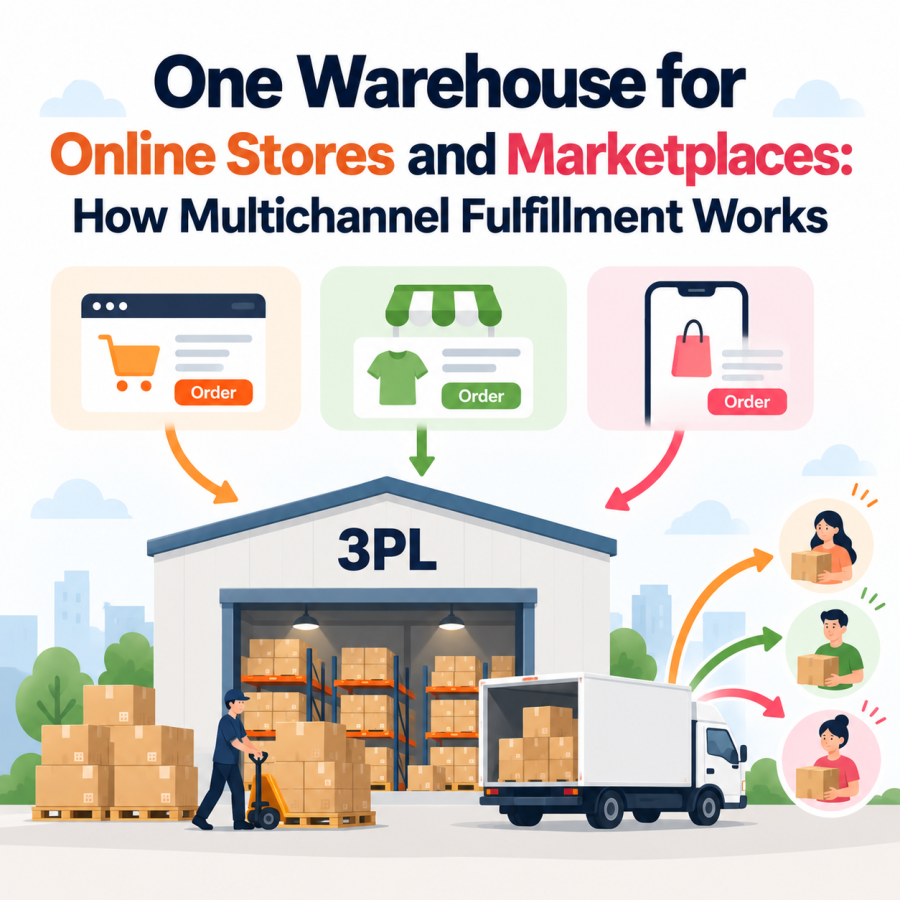
Multichannel fulfillment means one logistics operation fulfills orders from several sales channels. Think of it as one stockroom serving several cash registers. Each channel is a “register” where customers place orders. The stockroom is where the products actually sit, get picked, packed, and shipped.
In practice, the warehouse receives your inventory once, stores it under your account, and fulfills orders as they arrive from connected channels. For Amazon orders fulfilled by the seller (FBM), Shopify orders, and eligible TikTok Shop orders, products can ship from the same warehouse inventory. Amazon FBA orders, by contrast, are fulfilled from Amazon’s own network.
The word “omnichannel” is often used to mean the same thing, with an added emphasis on giving customers a consistent experience across channels. For most small and mid-size brands, the day-to-day question is the practical one: can a single warehouse and a single inventory count support all of my channels?
Do You Need Separate Inventory for Each Channel?
Not always, but it depends on how you sell. There are three common setups.
- Separate stock for each channel. Each channel has its own units, for example units stored at Amazon for FBA, units at your own warehouse for Shopify, and units at a TikTok fulfillment center if you use Fulfilled by TikTok. This is simple to understand, but stock can sit idle in one place while another channel runs out.
- One shared pool at a 3PL. Your connected channels draw from the same inventory in one warehouse. This reduces idle stock and gives you one number to manage, but it requires good order and inventory connections between your channels and the warehouse.
- A hybrid. Many brands use a mix: FBA for fast Amazon delivery on core SKUs, with a 3PL holding the rest and serving Shopify, TikTok Shop, wholesale, or other channels.
Amazon also offers its own multichannel option. Amazon Multichannel Fulfillment (MCF) lets sellers fulfill orders from their own websites, social media channels, and other online stores using inventory in Amazon’s fulfillment network, which can share one pool with FBA. It is a legitimate alternative for brands that want to keep everything inside Amazon’s network. A third-party 3PL is another approach, and can be a good fit when a brand wants one independent warehouse that it controls across all channels, including wholesale accounts or specialized packaging and prep needs. The options on each side change over time, so the right choice depends on your products, channels, and costs.
One more point is worth knowing. Shopify tracks inventory by location, and each location’s stock is independent and is not pooled with other locations inside Shopify. In a multichannel setup, the pooling happens in the warehouse’s system, which then reports available quantities to each channel. That is why the connection between your channels and the 3PL matters as much as the warehouse itself.
How One 3PL Handles Multiple Sales Channels
Behind the scenes, the flow is straightforward:
- Inventory arrives once. Your freight is received at the 3PL, counted against your documents, and entered into the warehouse management system (WMS) by SKU.
- Channels connect to the WMS. Each sales channel is linked to the warehouse, either directly or through an integration or order-management tool. How this works varies by channel and by 3PL.
- Orders flow in. When a customer orders on any channel, the order goes to the warehouse.
- The warehouse picks, packs, and ships. The same team handles all channels, applying the packaging, labeling, and shipping rules for each one.
- Tracking goes back to the channel. Shipping confirmation and tracking are sent back so the marketplace or store can update the customer.
- Inventory counts update. The WMS reduces available stock, and that new quantity is sent to each channel.
The details are where multichannel setups succeed or fail. Before you choose a provider, ask which of your channels it connects to, whether those connections are direct or through a third-party tool, and who is responsible when an order does not sync.
Inventory Synchronization
Inventory synchronization means that when an order is placed on one channel, the shared available inventory is adjusted and the updated quantity is communicated to the other connected channels. The timing depends on the warehouse management system, integration, and inventory reservation rules. Delayed updates can lead to overselling, especially during high-volume promotions: a customer buys something you no longer have.
Overselling is more than an inconvenience. TikTok Shop, for example, counts seller-fault cancellations, including cancellations caused by lack of inventory, toward a seller’s cancellation rate, and poor performance metrics can lead to enforcement on the platform. Other marketplaces have their own performance standards, so confirm the current rules for each channel you use.
A few practices help keep counts accurate:
- Use one source of truth. The warehouse’s inventory system should be the master count, with channels reading from it rather than keeping separate numbers.
- Check how often counts sync. A near-real-time update is much safer than an update once a day, especially during promotions.
- Consider safety stock. Many brands hold back a small buffer per channel, or reserve stock for the channel where a stockout would hurt most.
- Plan for stock held at Amazon or TikTok. Inventory that sits inside FBA or Fulfilled by TikTok is managed by those platforms and is separate from what is at your 3PL, so treat it as its own bucket in your planning.
- Run regular cycle counts. Even good systems drift, and regular counts catch differences before customers do.
Marketplace vs. DTC Orders
Not all orders are the same, even when they come from the same warehouse. Marketplace orders and direct-to-consumer (DTC) orders have different rules.
Marketplace orders (Amazon, TikTok Shop) come with platform requirements. For Amazon orders you ship yourself, sellers set a handling time and are expected to confirm shipment within it, entering tracking information or buying labels through Amazon. Programs such as Seller Fulfilled Prime have additional performance requirements. TikTok Shop’s policy sets dispatch and delivery windows for regular orders, and TikTok Shipping labels are provided by TikTok when you use that option. In general, marketplaces measure how quickly and reliably you ship, so your 3PL’s cut-off times and turnaround matter.
DTC orders (Shopify) give you more control. You choose the carriers, shipping speeds, packaging, inserts, and branding, and you set your own return policy. That flexibility is useful, but it also means you carry the customer experience more directly.
Because the rules differ, ask your 3PL how it handles each type: whether it can apply different packaging and labeling by channel, how it handles marketplace label requirements, and what its cut-off time is for same-day or next-day shipping. Marketplace policies change, so check each platform’s current requirements instead of assuming they stay the same.
Returns Across Multiple Channels
Returns are where multichannel gets messy, because each channel has its own return rules, timelines, and addresses. A return from Amazon is not handled the same way as a return from TikTok Shop or Shopify.
For example, TikTok Shop’s current policy sets a default return window and expects sellers to review requests within stated timeframes, to keep their return warehouse address up to date, and, for seller-managed returns, to assess and grade the returned item in Seller Center. Amazon and your own Shopify store each have their own processes and policies.
A 3PL can help by:
- Receiving returned packages at a single return address, or at separate addresses set up per channel
- Identifying which channel a return belongs to
- Inspecting items and recording their condition against agreed grading criteria
- Restocking sellable units back into the shared inventory pool, and updating the count on every channel
- Separating damaged or unsellable items for disposal, repair, or review
Before you start, agree in writing which return steps the 3PL performs, such as inspection, photos, or grading, because the scope varies by provider and contract. Check each channel’s current return policy so your process matches it.
When Multichannel Fulfillment Makes Sense
A single 3PL serving several channels is generally worth considering when:
- You sell on two or more channels and the same products appear in each
- Separate stock keeps leaving some channels overstocked and others out of stock
- Your order volume is large enough that managing shipping yourself takes too much time
- You want one packing standard, one set of reports, and one inventory count
- You need warehouse space, prep, or fulfillment that does not depend on any single platform
It may be less necessary when you sell a few units a day on a single channel, or when most of your volume already moves through one platform’s own fulfillment network and works well. The added integration work and handling cost may not pay off in those cases. As with any logistics decision, compare the full cost of each approach, including storage, handling, shipping, integration, and platform fees, before you commit.
Key Takeaway
Multichannel fulfillment comes down to one idea: keep inventory in one place, and let your connected sales channels draw from it. Done well, it reduces idle stock, simplifies counts, and gives each customer a consistent experience. Done poorly, it creates overselling and returns confusion. What separates the two is mostly the connections between your channels and the warehouse, and a clear agreement about who does what, so those are the questions to settle before you choose a provider.
PNP LINE supports ecommerce brands with U.S. warehousing, inventory management, order fulfillment, and returns handling for multi-channel sellers, alongside international freight forwarding and customs clearance coordination through licensed customs broker partners for brands importing inventory. Learn more about our Texas warehouse and international freight forwarding services.
📋 Request an Online Quote https://www.pnpline.com
Source References
- Amazon, “Multichannel Fulfillment” (Amazon Selling Partners) — https://sellingpartners.aboutamazon.com/multi-channel-fulfillment
- Amazon, “Amazon FBM (Fulfilled by Merchant)” (Sell on Amazon) — https://sell.amazon.com/programs/fulfilled-by-merchant
- Shopify Help Center, “Fulfillment options” — https://help.shopify.com/en/manual/fulfillment/setup/fulfillment-options
- Shopify Help Center, “Managing inventory across multiple locations” — https://help.shopify.com/en/manual/inventory-and-locations/setup/multi-managed-inventory
- TikTok Shop Academy (US), “Fulfillment Policy” — https://seller-us.tiktok.com/university/essay?knowledge_id=3995852763301633&lang=en
- TikTok Shop Academy (US), “Customer Order Cancellation, Return, and Refund Policy” (page dated October 21, 2026) — https://seller-us.tiktok.com/university/essay?knowledge_id=3253210454181634&lang=en
Disclaimer: Marketplace and platform policies for Amazon, Shopify, TikTok Shop, and other channels, including fulfillment options, shipping and return rules, performance metrics, and fees, change frequently and can differ by seller account and product category. This article is provided for general informational purposes and does not constitute legal, tax, or platform-policy advice. Sellers should confirm current requirements in each platform’s seller tools and with their logistics provider before making inventory or fulfillment decisions.
#3PL for Amazon Shopify and TikTok orders, #multichannel fulfillment 3PL, #Amazon Shopify TikTok fulfillment, #one warehouse multiple sales channels, #omnichannel fulfillment USA, #ecommerce 3PL multiple marketplaces