KR
Most international brands start the same way: a customer in the U.S. places an order, and the product ships directly from the home country via international parcel post or courier. It works fine at low volume. The problem is that this model doesn’t get better as sales grow — it tends to get harder and slower to manage per order, while U.S. customers compare the experience against domestic brands that often deliver in a few days.
The alternative isn’t opening a U.S. warehouse yourself. It’s storing inventory with a U.S. third-party logistics (3PL) provider, so orders ship from inside the U.S. instead of across an ocean every time. Here’s where the direct-shipping model breaks down, and how the 3PL alternative actually works.
Why Shipping Every Order Internationally Becomes Difficult
Shipping each order individually from overseas means every single parcel goes through the full international shipping process — customs documentation, international postal or courier handling, and a transit time typically measured in weeks rather than days. A few things compound as volume increases:
- Delivery time is a built-in disadvantage for many shipments. International delivery can range from several days by express courier to multiple weeks by postal or economy services, while domestic fulfillment generally offers shorter and more predictable transit times. A longer or less predictable shipping estimate at checkout can contribute to cart abandonment.
- Every parcel now runs through standard customs requirements. The $800 “de minimis” exemption that used to let low-value shipments enter the U.S. duty-free has been indefinitely suspended for goods arriving through all shipping modes, from any country. That means a brand shipping orders one at a time from overseas can no longer rely on automatic duty-free treatment — each parcel is generally subject to applicable customs entry and duty requirements rather than automatically qualifying for duty-free de minimis treatment, which adds cost and complexity to every single order.
- Scale doesn’t automatically lower the cost of shipping across borders. Although high-volume shippers may negotiate better international parcel rates, shipping each order across borders still carries international transportation and customs-related costs that domestic fulfillment can avoid at the individual-order level.
- Returns are a common deterrent. Asking a U.S. customer to mail a return back overseas is slow and often expensive for the customer, which can discourage customers from completing a return or exchange — potentially meaning lost repeat business rather than just an absorbed cost.
None of this is fatal at low order volume. But as a brand’s U.S. sales grow, these costs and delays scale directly with order count, and at some point the economics flip in favor of a different model.
Store Inventory Closer to U.S. Customers
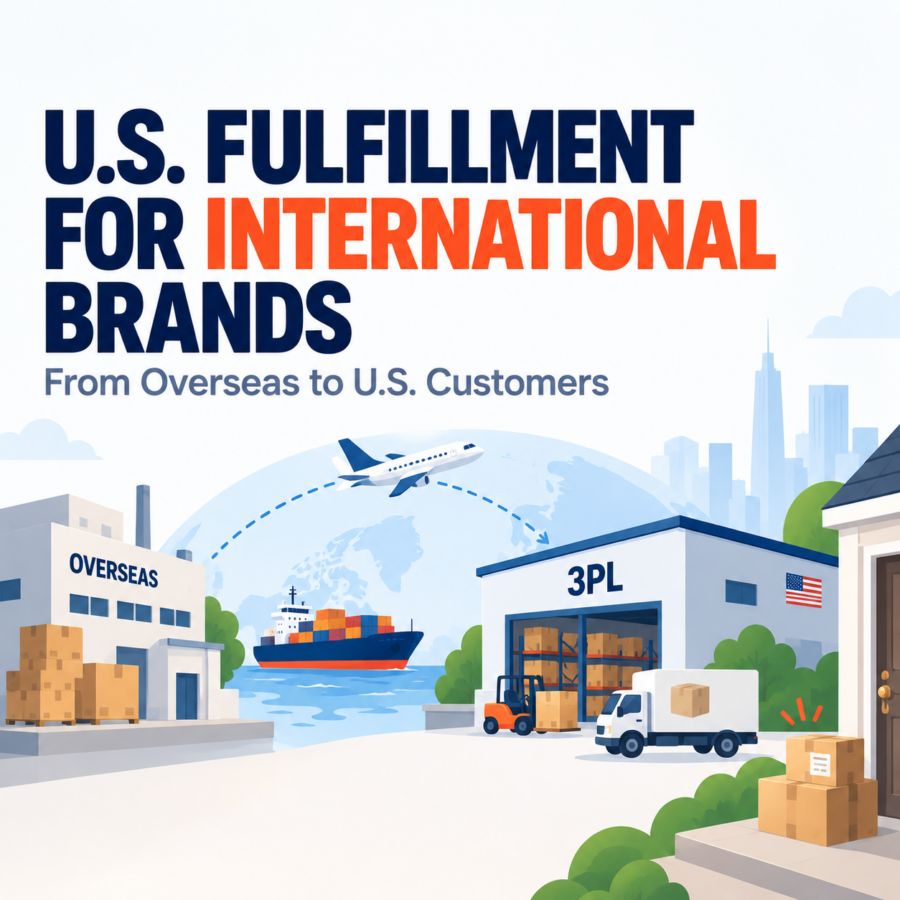
The alternative model is straightforward: instead of shipping individual orders from overseas, you ship inventory in bulk to a U.S. 3PL warehouse ahead of time, import the inventory in bulk through the commercial customs clearance process, and then fulfill each U.S. order domestically from there. The product still travels internationally — it just does so as one consolidated shipment instead of as hundreds or thousands of individual parcels.
This shifts the economics in a specific way: international freight and customs-related costs are consolidated around bulk inventory shipments rather than incurred separately for each direct-to-consumer parcel, and the per-order cost becomes a domestic shipping rate — typically faster and cheaper than an equivalent international parcel.
How a U.S. 3PL Works
A U.S. 3PL operates as a warehousing and fulfillment service: it receives your inventory, stores it, and ships individual orders as they come in, without you needing a local office, warehouse lease, or on-site staff. You typically connect the 3PL to whatever sales channel you’re using — your own website, a marketplace account, or both — so orders flow into the fulfillment queue automatically rather than requiring manual processing on your end.
Getting inventory into the warehouse in the first place is its own logistics step, usually handled through an international freight forwarder managing ocean or air shipping and the customs clearance process, before the goods are delivered to the 3PL.
Receiving Overseas Inventory
Once a bulk shipment arrives at the 3PL, it goes through a receiving process before it’s available to sell: verifying the quantity and condition against your packing list, assigning storage locations, and updating the inventory management system so stock levels are visible in close to real time. Sending an advance shipping notice (ASN) before the shipment arrives — what’s coming, in what quantities — helps the warehouse plan for it rather than reacting cold when a container or pallet shows up.
For a brand used to tracking inventory that’s sitting entirely overseas, this is also the point where inventory visibility typically improves: most 3PLs provide a dashboard or system integration showing exactly what’s in stock, where, and how it’s moving, which is harder to maintain when inventory and orders are split across two continents.
Pick, Pack and Ship
Once inventory is in the warehouse, order fulfillment works the same way it would for a domestic brand. As orders come in, the 3PL picks the items, packs them, and ships them using domestic carriers like USPS, UPS, or FedEx, generally offering shorter and more predictable transit times than direct international shipping, which can range from several days by express courier to multiple weeks by postal or economy service. For brands selling through more than one channel, this also means orders from different sources can be fulfilled from a single, shared inventory pool rather than needing separate processes for each.
Returns and Inventory Management
Returns work locally too: a U.S.-based 3PL can receive, inspect, and process returns domestically instead of a customer mailing an item back overseas — which is both faster for the customer and keeps the brand’s return experience closer to what they’d get from a U.S.-based competitor.
On the inventory side, having stock physically located in the U.S. also changes how replenishment planning works. Instead of placing one large order and waiting weeks for the next overseas shipment to land if you run low, many brands shift toward a steadier cadence of bulk shipments into the 3PL, sized around actual U.S. sell-through rather than guesswork based on estimated international transit time.
When Should an International Brand Start Using a U.S. 3PL?
There’s no single volume threshold that applies to every brand, since it depends on your margins, product size and weight, and how much of your sales growth is coming from the U.S. specifically. That said, a few signals tend to indicate the direct-shipping model is becoming the limiting factor rather than a minor inconvenience:
- U.S. order volume has grown to the point where per-parcel international shipping and customs costs are a significant, recurring expense rather than an occasional one.
- Customers are citing slow delivery time or confusing customs charges in reviews, support tickets, or cart abandonment patterns.
- Returns volume or return-related complaints are rising, and the overseas return process is a visible pain point.
- You’re already selling through a U.S. marketplace or platform that rewards (or requires) faster, more reliable delivery performance.
For brands seeing any of these signals, the practical next step is usually a trial shipment — sending a modest amount of inventory to a U.S. 3PL to test fulfillment performance and U.S. demand, before committing to a larger, ongoing shipping cadence.
Key Takeaway
Shipping every U.S. order directly from overseas is a workable starting point, but it’s a model that gets more expensive and slower exactly as a brand’s U.S. business grows — each parcel must now be handled under applicable customs entry and duty requirements rather than relying on the former de minimis exemption, international delivery times are often longer and less predictable than domestic shipping, and returns are a built-in friction point. Storing inventory with a U.S. 3PL consolidates international freight and customs-related costs around bulk inventory shipments rather than incurring them on every individual order, while giving U.S. customers the faster, more predictable delivery and simpler returns they expect from a domestic seller.
Looking for a way to fulfill U.S. orders without shipping every parcel internationally? PNP LINE helps international brands move inventory from overseas into U.S. warehousing, with freight forwarding, customs clearance coordination, and U.S. warehousing managed as part of a coordinated logistics process. Learn more about our international freight forwarding, U.S. customs clearance, and 3PL and e-commerce fulfillment services.
📋 Request an Online Quote https://www.pnpline.com
Source References
- Federal Register, “Indefinite Suspension of the De Minimis Exemption for Merchandise Arriving Through All Modes Other Than the International Postal Network,” effective June 24, 2026 — https://www.federalregister.gov/documents/2026/06/24/2026-12670/indefinite-suspension-of-the-de-minimis-exemption-for-merchandise-arriving-through-all-modes-other
- Federal Register, “Indefinite Suspension of the De Minimis Exemption for Mail Shipments and New Postal Informal Entry Process,” effective June 24, 2026 — https://www.federalregister.gov/documents/2026/06/24/2026-12669/indefinite-suspension-of-the-de-minimis-exemption-for-mail-shipments-and-new-postal-informal-entry
Disclaimer: Shipping costs, transit times, and customs requirements vary by product, origin country, carrier, and shipment value, and can change with little notice. This article is provided for general informational purposes. Brands should confirm current international shipping options and customs requirements with their freight forwarder or customs broker for their specific products and routes.
#how to fulfill US orders from overseas, #US fulfillment for overseas sellers, #international ecommerce fulfillment USA, #3PL for international sellers, #US warehouse for overseas brands, #US order fulfillment international company