KR
For an international brand selling through Fulfillment by Amazon (FBA), the temptation is to ship every unit that lands in the United States straight into Amazon’s network. It looks simple: fewer handoffs, one set of tracking numbers, and inventory that is “ready to sell” the day it arrives.
In practice, many international sellers find that sending everything to Amazon at once creates its own problems — capacity limits, inbound fees, prep requirements, and cash tied up in stock that may not sell for months. That is why a growing number keep a portion of their inventory at a U.S. 3PL warehouse and feed it into FBA in measured batches. This guide explains how that buffer inventory model works, when it helps, and what to prepare before you try it.
What Is FBA Buffer Inventory?
FBA buffer inventory is stock you own that is held outside Amazon’s fulfillment centers — typically at a third-party logistics provider (3PL) — and used to replenish FBA as units sell. Think of it as a reserve tank: Amazon’s warehouses hold the inventory needed for the next few weeks of sales, while the 3PL holds the rest.
The model is common among importers because freight arrives in large batches (a full container or a pallet-load from overseas), while Amazon sales happen one unit at a time. A buffer warehouse bridges that gap, so a single ocean shipment can supply FBA across several replenishment cycles instead of all at once.
Why Not Send Everything to Amazon?
Amazon’s own systems are designed to limit how much inventory any seller can hold. A few reasons sellers choose not to send an entire shipment to FBA at once:
- Capacity limits. Amazon generally applies monthly FBA capacity limits, measured in cubic feet, although certain seller accounts, including newer professional selling accounts, may be exempt. Where a limit applies, it caps how much inventory a seller can send to and store at Amazon. The limit counts both inventory already in fulfillment centers and inbound shipments, and Amazon publishes updated limits each month in the Capacity Monitor in Seller Central. Your limit can change based on factors such as sales forecasts and your Inventory Performance Index (IPI) score. If your container holds more than your limit allows, the extra units have nowhere to go on the Amazon side.
- Storage and aged-inventory costs. Inventory that sits at Amazon longer than expected can attract storage-related charges, and Amazon periodically adjusts its fee schedule. Confirm the current rates in Seller Central rather than relying on a general rule of thumb.
- Inbound placement costs. Amazon offers different inbound placement options — for example, sending inventory to fewer receiving locations or to more locations — and charges an inbound placement service fee on some options. The fee depends on the option you choose and the product, so it is worth comparing estimates before each shipment.
- Cash flow. Inventory you hold at your own 3PL can be adjusted, reallocated to another sales channel, or reprepared if your listing changes. Inventory already inside Amazon’s network is less flexible to redirect.
None of this means FBA is the wrong choice for international sellers. It means that how much inventory you place inside Amazon, and when, is a decision worth managing deliberately.
How 3PL Storage Works
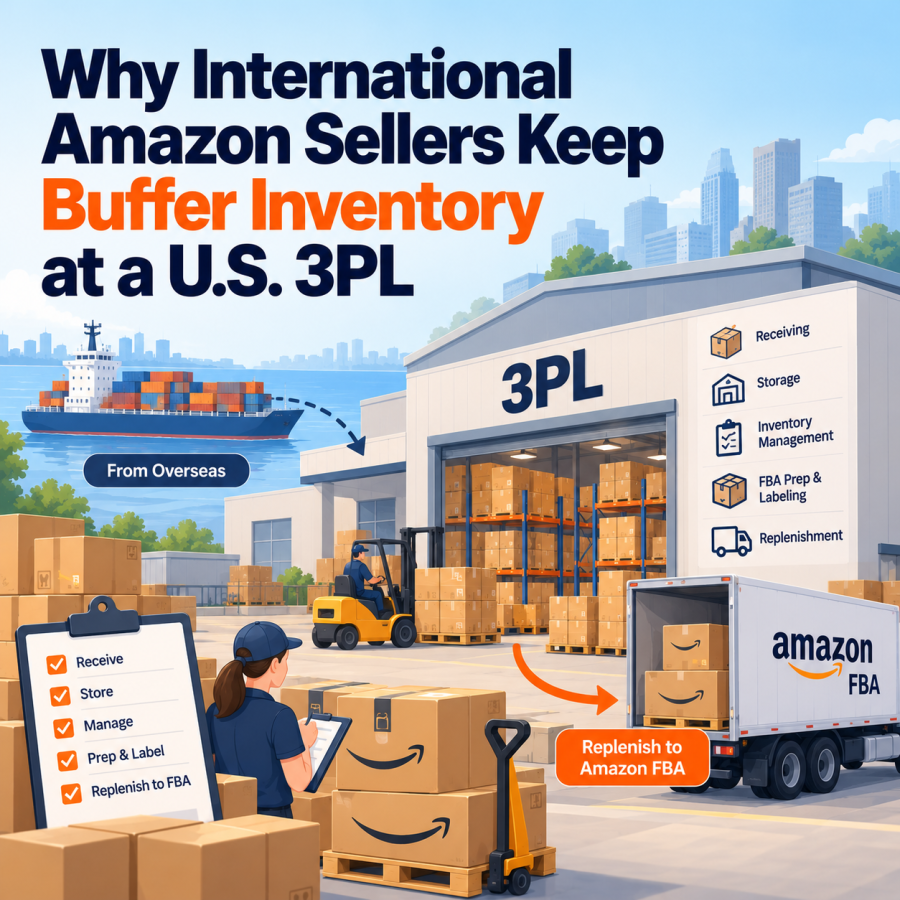
When an international shipment arrives in the U.S., it can be received at a 3PL warehouse instead of going directly to Amazon. The typical flow looks like this:
- Freight arrives. The container or pallet shipment clears U.S. customs and is delivered to the 3PL, usually by a drayage or trucking carrier.
- Receiving. The 3PL unloads the shipment, checks quantities and visible condition against the shipping documents, records any discrepancies, and enters the inventory into its warehouse management system (WMS).
- Storage. Units are stored by SKU, usually on pallets or shelving, with inventory counts visible to the seller.
- Replenishment as needed. When FBA stock runs low, the seller requests a replenishment batch, and the 3PL prepares and ships it.
Because the 3PL holds the inventory under your account, you can also use the same stock for other channels, such as your own website or wholesale accounts, instead of tying it to Amazon alone.
Replenishing Amazon FBA Inventory
Replenishment is where a buffer warehouse earns its place. Rather than guessing how much to send, many sellers set a regular cycle — for example, reviewing FBA stock levels weekly or monthly — and send enough units to cover the next sales window while staying within their capacity limit.
A typical replenishment workflow includes:
- Reviewing FBA inventory levels and sales velocity in Seller Central
- Creating a shipment plan in Send to Amazon (or through Amazon’s APIs) for the SKUs and quantities needed
- Having the 3PL pick, prep, label, and pack the units according to that plan
- Shipping to the Amazon-assigned destination by small parcel or by pallet via LTL or FTL freight, depending on shipment size
Keeping replenishment batches smaller and more frequent can help sellers avoid running out of stock while also avoiding excess inventory at Amazon.
Amazon also offers its own bulk-storage option, Amazon Warehousing and Distribution (AWD), which holds inventory in bulk and can replenish FBA automatically. AWD is a legitimate alternative for sellers who want to keep everything within Amazon’s ecosystem, and it comes with its own product eligibility rules, box-size limits, and fee structure. A U.S. 3PL is another approach — particularly useful for sellers who also sell outside Amazon, who have products AWD does not accept, or who want a single warehouse partner to handle prep, storage, and multichannel fulfillment. The right choice depends on your products, channels, and cost structure.
Preparing Inventory Before FBA
Preparation matters more than it used to. Amazon announced that, beginning January 1, 2026, it would stop providing prep and item-labeling services for FBA shipments in the U.S. store. Inventory generally needs to arrive at an Amazon fulfillment center already labeled, packaged, and ready to ship. According to responses from Amazon staff in Seller Central discussions, products that arrive without proper prep or labeling may not be eligible for reimbursement if they are lost or damaged, and prep issues are surfaced as defects in the Inbound Performance Dashboard. Details of the policy can change, so sellers should review Amazon’s current prep requirements in Seller Central before shipping.
For international sellers, this is a good reason to complete prep in the U.S. before inventory goes to FBA — rather than relying on Amazon to fix problems after arrival. A 3PL that supports FBA prep can typically handle steps such as:
- Labeling. Applying product barcode labels where required. Amazon has said it is ending commingling for inventory shipped on or after March 31, 2026; as a result, resellers generally need Amazon barcode stickers even if the product already has a manufacturer barcode, while brand owners with the appropriate Brand Registry role may be able to use manufacturer barcodes on eligible products. Which rule applies to your products depends on your account and listing, so confirm it in Seller Central.
- Poly-bagging, bundling, or other packaging steps that Amazon requires for certain product types.
- Carton and pallet labeling and packing that follow Amazon’s inbound requirements, including carton content information and pallet preparation for freight shipments.
- Palletizing. Building and labeling pallets for LTL or full-truckload deliveries when shipping larger quantities to Amazon.
Prep scope varies by 3PL, and detailed inspections or value-added services are generally provided according to the agreed scope of work. Make sure your service agreement spells out exactly which steps the 3PL will perform and who is responsible if an error is found later.
When Buffer Inventory Makes Sense
A U.S. 3PL buffer warehouse is generally worth considering when:
- Your inbound freight volume regularly exceeds your Amazon capacity limit or what your FBA sales can absorb in the near term
- You want to replenish FBA in smaller batches rather than sending a full container at once
- You sell on more than one channel and want a shared inventory pool
- You need prep, labeling, or repacking done in the U.S. before inventory reaches Amazon
- You want flexibility to hold, rework, or reroute stock if listings, packaging, or demand change
It may be less necessary when you sell a small number of fast-moving SKUs that fit comfortably within your Amazon capacity limit and turn over quickly, since the added handling step and storage cost may not offset the benefit. As with any logistics decision, the answer depends on your volumes, product mix, and cost structure — compare the full landed cost of each approach, including storage, handling, transportation, and Amazon’s applicable fees, before committing.
Key Takeaway
For international Amazon sellers, buffer inventory at a U.S. 3PL is a way to separate two different jobs: bringing freight into the United States in efficient bulk shipments, and feeding Amazon the right amount of inventory at the right time. With Amazon’s capacity limits, inbound placement fees, and prep requirements all affecting how much you can send and how it must arrive, a buffer warehouse gives you room to plan rather than react.
PNP LINE supports international Amazon sellers with U.S. warehousing, inventory storage, FBA prep and labeling coordination, palletizing, and replenishment shipments, alongside international freight forwarding and customs clearance coordination through licensed customs broker partners to get inventory to the U.S. in the first place. Learn more about our Texas warehouse and international freight forwarding.
📋 Request an Online Quote
https://www.pnpline.com
Source References
- Amazon, “Amazon announces new streamlined FBA capacity management system” (Sell on Amazon blog) — https://sell.amazon.com/blog/announcements/fba-capacity
- Amazon, “2026 Amazon Referral & FBA Fee Updates” (Selling Partner Blog, announced October 15, 2025) — https://sellingpartners.aboutamazon.com/update-to-u-s-referral-and-fulfillment-by-amazon-fees-for-2026
- Amazon, “How Amazon Warehousing and Distribution (AWD) can make your supply chain and Amazon FBA work better” (Sell on Amazon blog, June 5, 2025) — https://sell.amazon.com/blog/send-products-to-amazon-warehousing-and-distribution
- Amazon Seller Central Forums, “Commingling practices will end effective March 31, 2026” — https://sellercentral.amazon.com/seller-forums/discussions/t/106d0747-e5c6-44d8-86f3-7669f11238fe
- Amazon Seller Central Help, FBA prep and labeling requirements — https://sellercentral.amazon.com/help/hub/reference/G201023020
- Amazon Seller Central Forums, “New FBA Prep Rule (Jan 1, 2026) – Seller Risk & Unplanned Prep Fees” (responses from Amazon staff) — https://sellercentral.amazon.com/seller-forums/discussions/t/32e1d348-10b4-46ae-ae29-74a0cb3b182a
- Packaging Insights, “Amazon ends US prep and labeling services in 2026 to boost efficiency” (industry reporting on the January 1, 2026 prep change) — https://www.packaginginsights.com/news/amazon-fba-packaging-labeling-changes-2026.html
Disclaimer: Amazon’s FBA policies, capacity limits, fees, prep and labeling requirements, and eligibility rules change frequently and can differ by seller account, product category, and shipment. This article is provided for general informational purposes and does not constitute legal, tax, customs, or Amazon-policy advice. Sellers should confirm current requirements in Seller Central and with their logistics provider before making inventory or shipping decisions.
#warehouse for Amazon FBA buffer inventory, #Amazon FBA replenishment 3PL, #Amazon inventory storage 3PL, #Amazon FBA overflow storage, #FBA inventory warehouse, #3PL for Amazon sellers