KR
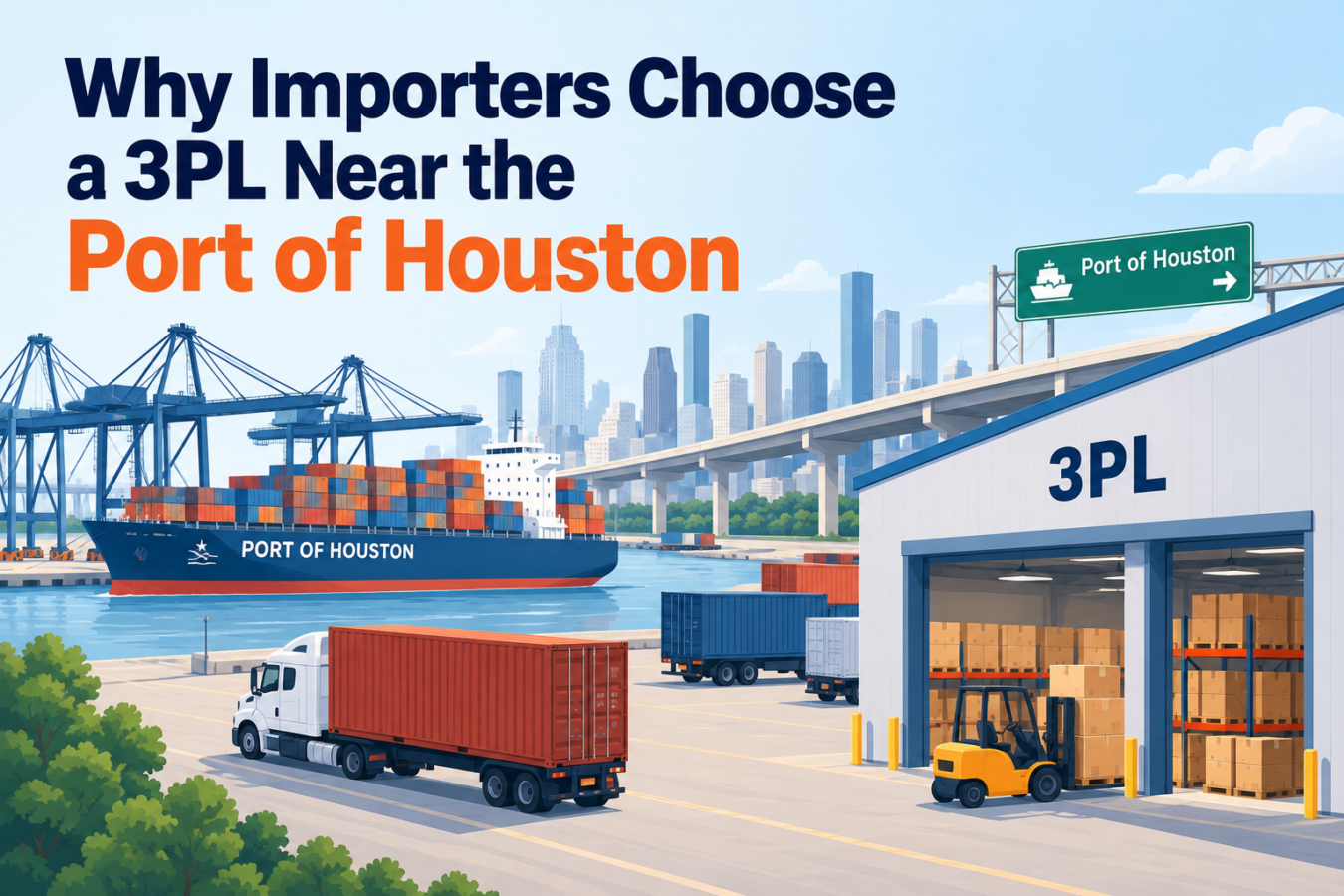
Not every importer needs a warehouse on the West Coast or in New Jersey. For companies whose customers, suppliers, or distribution networks sit in Texas, the broader Gulf Coast, or the South-Central U.S., a 3PL warehouse near the Port of Houston can shorten the distance between “container arrives” and “product reaches the customer” in a way that a facility on the other side of the country can’t.
This isn’t a claim that Houston is the right choice for every importer — it depends heavily on where your freight originates and where your customers actually are. But for the right distribution profile, the Port of Houston’s combination of container volume, terminal infrastructure, and inland connectivity makes a strong case.
Why Houston Matters for U.S. Importers
Port Houston is the fifth-ranked U.S. container port by total TEU volume, and the largest container port on the Gulf Coast, handling roughly three-quarters of all Gulf Coast container traffic and about 97% of Texas’s container volume. Container throughput has continued to grow — the port handled just over 1.08 million TEUs in the first quarter of 2026, up modestly over 2025’s already-record pace, with loaded imports specifically up 7% in March.
Part of what’s driving that growth is a broader shift in how importers think about routing. Rather than relying on a single coast, more shippers have spread volume across multiple gateways to reduce exposure to congestion or disruption at any one port — and Houston has been a consistent beneficiary of that diversification, particularly for cargo originating in Asia via the Panama Canal or from Latin America and Europe via more direct Gulf and Atlantic routings.
Port Houston continues to invest in terminal capacity and infrastructure, including the Houston Ship Channel Expansion (Project 11), berth and wharf improvements, and the acquisition of new ship-to-shore and hybrid rubber-tired gantry cranes.
None of this means Houston replaces the West Coast or the Northeast for importers whose business is concentrated there. It means Houston has become a more capable, more heavily used gateway than it was a few years ago — which is relevant mainly if your supply chain or customer base already has a Gulf Coast or South-Central footprint.
Port-to-Warehouse Transportation
Getting a container from the terminal to a warehouse is its own logistics step, and this is where proximity starts to matter in practical terms. A 3PL located close to the port can shorten the drayage leg — the trucking move from the terminal to the warehouse — and may help reduce transportation time and the risk of container detention or additional chassis rental charges, depending on terminal availability, warehouse scheduling, and equipment return requirements. (Demurrage, detention, and chassis rental are distinct charges — demurrage applies when a container isn’t moved out of the terminal in time, detention applies when an empty container isn’t returned within its free time after leaving the terminal, and chassis rental is billed separately based on how long the chassis is in use — and proximity to the port helps with some of these more directly than others.)
Houston’s container terminals also have direct rail connections: Barbours Cut Container Terminal offers on-dock intermodal service with both Union Pacific and BNSF, giving importers a rail option for cargo moving onward to inland markets without a separate drayage move to an off-site rail yard. For shipments staying within the region, Houston’s position on Interstate 10 (east-west), Interstate 45 (connecting to Dallas-Fort Worth and north Texas), and Interstate 69 (running toward the Midwest) puts a Houston warehouse within a reasonable truck haul of much of Texas and a meaningful share of the South-Central U.S.
Container Receiving
Once a container reaches a Houston-area 3PL, the receiving process looks the same as it would at any U.S. warehouse — unloading, verifying contents against the packing list, and getting inventory into the warehouse management system — but a shorter port-to-warehouse distance generally means more predictable receiving windows. A warehouse that isn’t waiting on a long-haul truck has an easier time coordinating labor around when containers are actually expected to arrive, rather than building in a wide buffer for transit uncertainty.
For importers running a mix of full container loads and less-than-container-load (LCL) shipments, LCL cargo is typically deconsolidated at a designated container freight station (CFS) before being transferred to a 3PL warehouse. Importers can coordinate this process with their freight forwarder to streamline delivery to their Houston-area storage facility, rather than routing LCL cargo through a different gateway city first.
Houston Inventory Storage
Beyond receiving, Houston offers importers a reasonably deep warehousing market with options across general dry storage, climate-controlled space, and facilities within or near Houston’s Foreign Trade Zone, which can be relevant for importers who want to defer, reduce, or in some cases eliminate duty on goods that are re-exported rather than sold domestically — a question worth discussing with a customs broker rather than assuming applies to your specific products.
For importers whose inventory strategy already involves holding safety stock closer to Gulf Coast or Texas demand, storing that inventory in Houston rather than shipping it in from a warehouse on another coast can shorten replenishment cycles to regional customers and reduce the domestic freight cost of getting product to where it’s actually being sold.
B2B and E-commerce Distribution
A Houston 3PL can support both bulk B2B shipments and individual e-commerce orders, though the considerations differ. For B2B distribution — full truckloads or LTL shipments to retailers, distributors, or wholesale accounts across Texas and the broader Gulf region — Houston’s highway and rail access shortens transit time to a meaningful share of that customer base. For e-commerce fulfillment, a Houston warehouse can provide relatively short parcel transit times to many Texas destinations and nearby South-Central markets, depending on the carrier, service level, and destination ZIP code, though it won’t outperform a more centrally located warehouse for truly nationwide delivery speed.
The practical takeaway is that Houston’s distribution advantage is regional rather than universal: it’s strongest for shippers whose demand is concentrated in or near Texas and the Gulf Coast, and more modest for sellers trying to reach the Pacific Northwest or New England quickly from a single facility.
When a Houston 3PL Makes Sense
A Houston-area 3PL is generally a strong fit when:
- A meaningful share of your customers, retail accounts, or distribution partners are in Texas, the Gulf Coast, or the broader South-Central U.S.
- Your import freight already routes efficiently to Houston — for example, via the Panama Canal from Asia, or more direct routings from Latin America or Europe — rather than requiring an awkward reroute to get there.
- You’re looking to diversify port and warehouse exposure away from a single coastal gateway, for resilience rather than cost alone.
- Your business involves industries with an established Gulf Coast presence — energy, petrochemicals, industrial equipment, and related sectors — where Houston’s existing logistics ecosystem and labor market are already built around similar freight.
It’s a weaker fit for an importer whose sales are concentrated on the West Coast or in the Northeast and have no particular reason to route cargo through the Gulf — in that case, a warehouse closer to that demand will usually outperform Houston on delivery speed, even if Houston’s port and terminal infrastructure is excellent on its own terms.
Key Takeaway
The Port of Houston’s growing container volume, direct rail access, and highway connectivity make a Houston-area 3PL a genuinely strong option for importers with Texas, Gulf Coast, or South-Central distribution needs — not because Houston is universally the best location in the country, but because its specific advantages (regional reach, port diversification, Gulf Coast industry alignment) line up well with a particular kind of supply chain. The right question isn’t whether Houston is a good port — the data says it clearly is — but whether your freight and your customers are actually positioned to benefit from a Gulf Coast gateway.
PNP LINE operates a Houston-area warehouse supporting container receiving, storage, and fulfillment for importers with Gulf Coast and Texas distribution needs, alongside ocean freight forwarding and customs clearance coordination through licensed customs broker partners to get cargo there in the first place. Learn more about our Texas warehouse, international freight forwarding, and U.S. customs clearance services.
📋 Request an Online Quote
https://www.pnpline.com
Source References
- Port Houston, “Port Statistics” — https://porthouston.com/about/our-port/statistics/
- Hoodline, “Port Houston Tops 1.09M TEUs In Q1 As Port Expands Capacity,” April 2026 — https://hoodline.com/2026/04/port-houston-blows-past-1-million-teus-as-ship-channel-stays-packed/
- Port Houston, “Rail Connectivity Enhances Efficiencies at Port Houston” — https://porthouston.com/rail-connectivity-enhances-efficiencies-at-port-houston/
- U.S. Department of Commerce, International Trade Administration, Foreign-Trade Zone 84 (Houston) zone details — https://ofis.trade.gov/Zones/Details/255
Disclaimer: Port statistics, terminal capabilities, and foreign-trade zone benefits can change and may vary by facility and product. This article is provided for general informational purposes. Importers should confirm current port, rail, and warehouse specifics with their logistics provider, and FTZ eligibility with a licensed customs broker, before making routing or facility decisions.
#3PL warehouse near Port of Houston, #Houston 3PL for importers, #Houston import warehouse, #Port of Houston warehouse, #Houston container warehouse, #Houston fulfillment center