KR
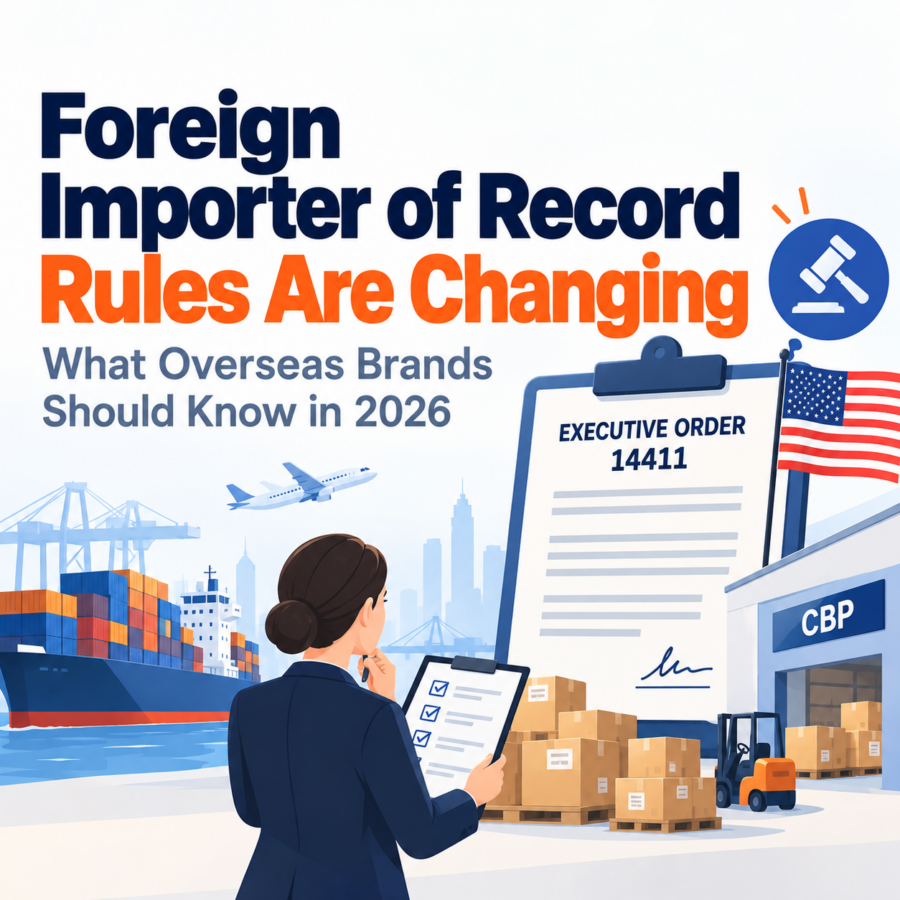
If your company has been acting as its own Importer of Record (IOR) for shipments into the U.S. — common for overseas manufacturers, Korean exporters, and international e-commerce brands alike — 2026 is the year that arrangement is getting harder to take for granted. Executive Order 14411, “Strengthening Customs Enforcement,” signed June 3, 2026, directs U.S. Customs and Border Protection (CBP) and the Department of Homeland Security (DHS) to specifically tighten the rules around who can serve as a foreign IOR, how they can file entries, and how closely they’re vetted.
The order itself isn’t a finished rulebook — it’s a set of instructions to CBP and DHS, with some changes already rolled out and others still working their way through rulemaking. That distinction matters, because a lot of what’s circulating online blends “already required” with “coming soon” without separating the two. Here’s where things actually stand as of this writing, and what overseas brands should be doing in the meantime.
What Executive Order 14411 Actually Directs
The order sets out a series of deadlines — 45, 90, and 180 days from its June 3, 2026 signing — along with some directives with no fixed date that CBP is told to act on “promptly.” The throughline across nearly all of it is a sharper distinction between domestic and foreign importers of record, with the order directing materially tighter requirements for foreign IORs than before.
Specifically, the order directs CBP and DHS to, among other things: restrict foreign IORs’ ability to file informal entries, impose additional formal-entry requirements (including CTPAT validation) on foreign IORs, limit foreign IORs’ use of continuous bonds, establish a “good standing” framework that can bar non-compliant importers from the system, revise penalty mitigation standards across the board, and build out enhanced, recurring vetting for IORs, brokers, and other bonded parties.
What’s Already in Effect
One concrete, dated change is confirmed as currently active:
- CBP Form 5106 data-accuracy enforcement (effective September 18, 2026). Following an August 19, 2026 Federal Register notice, CBP can now immediately void an Importer of Record number if the identification information on file — addresses, phone numbers, emails, EIN/SSN or CBP-assigned number — is inaccurate, incomplete, or doesn’t belong directly to the IOR. A voided number can’t be used to enter merchandise until it’s corrected and reestablished, which can stall shipments already in transit.
Separately, CBP was directed to revise its penalty mitigation standards — including a 50% minimum penalty floor and the elimination of mitigation for repeat violations — by a 90-day deadline around September 1, 2026. As of this writing, we have not been able to independently confirm that CBP has formally published these revised standards, so brands should confirm current penalty mitigation policy directly with their broker rather than assume the new floor is already being applied in practice.
What’s Still Being Finalized
Several of the changes most relevant to foreign IORs specifically are directed by the order but not yet locked in as final, enforceable rules:
- The informal entry prohibition for foreign IORs. The order directs CBP to bar foreign IORs from using informal entry procedures (generally available today for lower-value shipments) “promptly,” but without a fixed deadline. Some industry sources describe this as already functionally underway for certain low-value foreign-IOR entries; others describe it as still pending formal implementation. Given the inconsistency, this is worth confirming directly with your broker for your specific shipments rather than assuming either way.
- Mandatory CTPAT validation (or a CTPAT-validated broker) for formal entries. The order directs this requirement for foreign IORs making formal entries, but it isn’t yet confirmed as a hard, universally enforced requirement.
- Limits on continuous bonds for foreign IORs, restricting their use unless CBP is satisfied that U.S. revenue is protected and compliance is assured — directed, not yet finalized.
- A formal “good standing” framework, updated IOR registry, and risk-based compliance tiers, along with enhanced recurring vetting of IORs and brokers — these are part of the order’s 180-day deadline, which falls around November 30, 2026. This is arguably the most consequential upcoming date, since it’s when CBP and DHS are directed to revise the core importer eligibility regulations that determine who qualifies as an IOR in the first place.
- The “Heightened Import Disclosures for Supply Chain Visibility” advance notice of proposed rulemaking (ANPRM), issued September 2, 2026, which asks for public input on proposals like mandatory foreign export documentation submission and expanded party identification requirements. This is an early-stage proposed rule, not a final one — the comment period runs through December 1, 2026, and any resulting regulation would come later.
What This Means If You’re Currently Your Own IOR
For an overseas brand that has been importing under its own name — without a U.S. entity, using a CBP-assigned importer number and a customs bond — the practical direction of travel is clear even where the specific rules aren’t finalized yet: informal entry is becoming less available to foreign IORs, and formal entry is moving toward requiring either CTPAT validation of the foreign company itself or routing through a CTPAT-validated customs broker.
That generally leaves a few paths, and which one fits depends on your shipment profile, volume, and how your business is structured:
- Explore CTPAT validation for your own company, if eligible, and if the compliance investment makes sense at your import volume.
- Route formal entries through a CTPAT-validated customs broker, which for many overseas brands — particularly smaller or mid-sized importers — is the more practical near-term option, since it doesn’t require your company to go through CTPAT validation itself.
- Consider whether a U.S.-based party already in your supply chain or business relationships could take on the IOR role, in cases where that fits how your business is structured.
Each of these has different cost, timeline, and compliance implications, and the right answer depends on specifics a general article can’t resolve — this is a conversation for a licensed customs broker who can look at your actual import profile.
What Overseas Brands Should Do Now
A few concrete steps are worth taking regardless of how the remaining rulemaking shakes out:
- Check your CBP Form 5106 data today. Given that inaccurate information can now trigger immediate IOR number voiding, confirm your on-file addresses, contact details, and identification numbers are current and accurate before it becomes a shipment-blocking problem.
- Ask your broker directly whether they’re CTPAT-validated, and if not, understand what that means for your formal entries going forward.
- Review your bonding setup. The order directs limits on foreign IORs’ use of continuous bonds unless CBP is satisfied that U.S. revenue is protected and compliance is assured, so if your current IOR arrangement relies on a continuous bond, it’s worth understanding with your broker how that could be affected once this provision is finalized.
- Don’t assume your current informal-entry setup is permanent, especially for lower-value shipments, given the direction CBP has been told to move in.
- Watch the November 30, 2026 deadline. That’s when the order directs CBP and DHS to have revised the core IOR eligibility regulations and guidance.
Key Takeaway
Executive Order 14411 is a real and significant shift for foreign Importers of Record, but it’s being implemented in stages rather than all at once. What’s confirmed and active today is narrower than the full scope of the order: CBP Form 5106 accuracy enforcement is real now, while the informal-entry prohibition, mandatory CTPAT-or-broker requirement, bond limits, and the core IOR eligibility rewrite are still being finalized, with the 180-day mark (around November 30, 2026) as the next major checkpoint to watch. For overseas brands currently self-managing their IOR status, the practical move is to get ahead of the direction of travel — clean data, a confirmed CTPAT-validated broker relationship, and a plan B — rather than waiting for every rule to be finalized before adjusting.
Need help navigating foreign Importer of Record requirements as they change? PNP LINE works with licensed customs broker partners to help overseas brands keep shipments moving through U.S. customs clearance, alongside international freight forwarding and U.S. warehousing. Learn more about our U.S. customs clearance and international freight forwarding services.
📋 Request an Online Quote
https://www.pnpline.com
Source References
- Federal Register, “Strengthening Customs Enforcement” (Executive Order 14411), published June 10, 2026 — https://www.federalregister.gov/documents/2026/06/10/2026-11595/strengthening-customs-enforcement
- The White House, Executive Order 14411, “Strengthening Customs Enforcement,” June 3, 2026 — https://www.whitehouse.gov/presidential-actions/2026/06/strengthening-customs-enforcement/
- Federal Register, “Accuracy of Importer of Record Data Submitted to CBP,” published August 19, 2026, effective September 18, 2026 — https://www.federalregister.gov/documents/2026/08/19/2026-16911/accuracy-of-importer-of-record-data-submitted-to-cbp
- U.S. Customs and Border Protection, “CBP Announces Advance Notice of Proposed Rulemaking to Enhance Supply Chain Visibility,” September 2, 2026 — https://www.cbp.gov/newsroom/national-media-release/cbp-announces-advance-notice-proposed-rulemaking-enhance-supply
- Latham & Watkins, “New Executive Order Strengthening Customs Enforcement: What Importers Need to Know,” July 21, 2026 — https://www.lw.com/en/insights/new-executive-order-strengthening-customs-enforcement-what-importers-need-to-know
- RSM US, “Executive Order 14411 tightens rules for foreign importers of record” — https://rsmus.com/insights/services/business-tax/executive-order-14411-foreign-importers-record-rules.html
Disclaimer: Customs and Importer of Record requirements are changing under active federal rulemaking, and this article reflects publicly available information as of the date above. Several provisions described here are directed but not yet finalized, and implementation details, dates, and enforcement practices can change with little notice. This article does not constitute legal or customs compliance advice. Companies should confirm their current Importer of Record options and obligations with a licensed customs broker or qualified trade attorney before shipping.
#Foreign Importer of Record 2026, #FIOR USA, #foreign importer of record requirements, #US importer of record foreign company, #foreign IOR requirements 2026